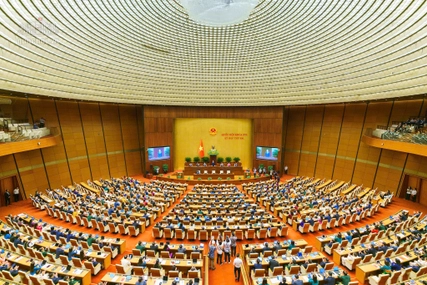
Draft amendments to the Land Law, the Law on Housing, and the Law on Real Estate Business are the discussion focus of legislators on October 22, part of the second session of the 16th National Assembly.
On October 20, 2026, the Government promulgated Decree No. 393/2026/ND-CP providing for foreign workers working in Vietnam, which takes effect on December 5, 2026.
LuatVietnam now has the full text of the Government’s Decree No. 393/2026/ND-CP providing for foreign workers working in Vietnam, promulgated on October 20, 2026
Under the Ministry of Finance’s Circular No. 156/2026/TT-BTC, from November 1, 2026, where a charge for exploitation and use of information in the National Synthetic Database has been collected more than once or in excess of the prescribed amount, the charge-collecting organization must refund the incorrectly collected amount to the charge payer.
This is prescribed in Circular No. 156/2026/TT-BTC providing for the rates, reduction, collection and remittance of the charge for exploitation and use of information in the National Synthetic Database, which takes effect from November 1, 2026.
On October 20, 2026, the Ministry of Finance promulgated Circular No. 156/2026/TT-BTC prescribing fee rates, reductions, collection and remittance for accessing and using information in the National Integrated Database.
Under new regulations of the Ministry of Foreign Affairs, presumptive expenditure for the negotiation of new treaties may reach VND 560 million, while a lower level applies to amended and supplemented treaties.
This change is prescribed in Decree No. 390/2026/ND-CP amending and supplementing Decree No. 24/2012/ND-CP on management of gold business activities, which was amended and supplemented under Decree No. 232/2025/ND-CP.
Official Dispatch No. 3164/DNTN-GS on inspections of enterprises’ declarations of beneficial ownership information was issued by the Agency for Private Enterprise and Collective Economy Development under the Ministry of Finance on October 7, 2026.
On July 22, 2026, the Government promulgated Decree No. 292/2026/ND-CP detailing a number of articles and measures for organizing and guiding the implementation of the Law on Foreign Trade Management, which takes effect on September 05, 2026.

 Vietnamese