
 Vietnamese
Circular 50/2026/TT-NHNN prescribing limits and prudential ratios in operations of commercial banks and foreign bank branches
- Summary
- Content
- Status
- Vietnamese
- Related documents
- Diagram
- Download
Please log in to your Advanced Package to view the full text. Do not have an account yet? Register here.
Please log in to use this function
Please log in to use this function
ATTRIBUTE
| Issuing body: | State Bank of Vietnam | Effective date: | Known Please log in to a subscriber account to use this function. Don’t have an account? Register here |
| Official number: | 50/2026/TT-NHNN | Signer: | Doan Thai Son |
| Type: | Circular | Expiry date: | Updating |
| Issuing date: | 30/09/2026 | Effect status: | Known Please log in to a subscriber account to use this function. Don’t have an account? Register here |
| Fields: | Finance - Banking |
The Effect status of this document is known.This feature is available to Advanced account holders. Please log in to a subscriber account to view Effect status. Don’t have an account? Register here
THE STATE BANK OF VIETNAM _________ No. 50/2026/TT-NHNN | THE SOCIALIST REPUBLIC OF VIETNAM Independence - Freedom - Happiness ______________________ Hanoi, September 30, 2026 |
CIRCULAR
Prescribing limits and prudential ratios in operations of commercial banks and foreign bank branches
Pursuant to the Law No. 46/2010/QH12 on the State Bank of Vietnam;
Pursuant to the Law No. 32/2024/QH15 on Credit Institutions, amended and supplemented by the Law No. 96/2025/QH15;
Pursuant to the Government’s Decree No. 26/2025/ND-CP defining the functions, tasks, powers and organizational structure of the State Bank of Vietnam, which is amended and supplemented by Decree No. 198/2026/ND-CP;
At the proposal of the Director of the Department of Banking System Safety;
The Governor of the State Bank of Vietnam hereby promulgates the Circular prescribing limits and prudential ratios in operations of commercial banks and foreign bank branches.
Chapter I
GENERAL PROVISIONS
Article 1. Scope of regulation
1. This Circular prescribes limits and prudential ratios which commercial banks and foreign bank branches (hereinafter referred to as banks) must constantly maintain in their operations, including:
a) Credit extension restrictions and limits;
b) Liquidity Coverage Ratio (LCR);
c) Net Stable Funding Ratio (NSFR);
d) Government bond and Government-guaranteed bond purchase, holding and investment ratios;
dd) Limits on capital contribution and share purchase;
e) Loan-to-Deposit Ratio (LDR);
g) Leverage Ratio (LEV).
2. During periods of special control, banks are not required to comply with Articles 136, 137, 138 and Clause 3, Article 144 of the Law No. 32/2024/QH15 on Credit Institutions, which is amended and supplemented by the Law No. 96/2025/QH15 (hereinafter referred to as the Law on Credit Institutions) and relevant provisions in this Circular.
3. Government bond and Government-guaranteed bond purchase, holding and investment ratios of supporting commercial banks and commercial banks being mandatory transferees are not restricted in accordance with Point d, Clause 1, Article 138 of the Law on Credit Institutions and relevant provisions in this Circular.
4. Banks financing programs or projects under decisions of the Government or Prime Minister, the consideration of capital sources and outstanding loan balance of each program or project upon determining limits and prudential ratios must comply with decisions of the Government or Prime Minister.
5. Based on the results of inspection, examination, and supervision of banks, in case of necessity to ensure safety in the operations of banks, depending on the nature and extent of risks, the State Bank of Vietnam (hereinafter referred to as the State Bank) has the right to request:
a) Banks to apply liquidity factors, inflow rates, run-off rates, Available Stable Funding factors (hereinafter referred to as ASF factors), and Required Stable Funding factors (hereinafter referred to as RSF factors) that are more stringent than those prescribed in this Circular for each balance portion or specific component when calculating the LCR and NSFR;
b) Banks that are no longer required to comply with the LDR as prescribed at Point d(ii), Clause 5, Article 13 of this Circular to resume compliance with the LDR as prescribed in this Circular upon request;
c) Banks to maintain one or several limit(s) or prudential ratio(s) more stringent than those prescribed in this Circular;
d) A maximum timeframe for banks to ensure compliance with the provisions of this Circular in case the implementation of the State Bank’s requests prescribed at Points a, b, and c of this Clause leads to banks violating the limits and prudential ratios prescribed in this Circular.
Article 2. Subjects of application
Banks, institutions and individuals related to limits and prudential ratios in operations of banks.
Article 3. Interpretation of terms
In this Circular, the terms below are construed as follows:
1. Clients in the relationships of credit extension, making deposits, and using other products and services provided by the bank (hereinafter referred to as clients) mean institutions (also including credit institutions and foreign bank branches) and individuals as defined by law.
A client can be an institution, an individual or another entity as defined by law.
2. Deposits mean the principal balance arising from the deposit-taking activities prescribed in the Law on Credit Institutions.
3. Valuable paper means a deed proving the debt obligation of its issuer toward its holder for a given period under interest payment terms and other terms. Valuable papers include bonds, sovereign bonds, treasury bills, deposit certificates and the like.
4. Corporate bond investment means purchase and holding of corporate bonds or entrustment of purchase and holding of corporate bonds to other institutions (including credit institutions and foreign bank branches). Holding corporate bonds does not include receiving corporate bonds as collaterals; or discounting and rediscounting corporate bonds.
5. Irrevocable describes agreements that have one or several of the following characteristics:
a) Agreements that cannot be canceled or altered in any form once they have been signed;
b) Agreements for which clients must pay a fee upon signing, and the cancellation of such agreements results in the bank having to pay compensation as signed.
6. Conditionally revocable describes an agreement that can be canceled upon the occurrence of one of the following events:
a) The client’s debt repayment capacity deteriorates as agreed upon, or when the client breaches the signed agreement;
b) The performance of the agreed obligations to the client leads to the bank violating the limits, prudential ratios, and other provisions of law at the time of disbursement, payment, or performance of other financial obligations as agreed with the client, unless otherwise prescribed at Point b, Clause 5 of this Article;
c) Other cases of cancellation not prescribed at Points a and b of this Clause, Point b, Clause 5, and Clause 7 of this Article.
7. Unconditionally revocable describes an agreement that can be canceled without any conditions or agreements with the client, which does not cause risks to the bank.
8. Credit extension for stock investment and trading means that a bank extends credit or entrusts credit extension in accordance with law to clients to use the capital for the purpose of stock investment and trading, or shareholding, or a bank extends credit facilities to a securities company to lend to other institutions and individuals for stock investment and trading, or shareholding.
9. Credit extension for corporate bond investment and trading means that a bank extends credit or entrusts credit extension in accordance with law to clients to use the capital for the purpose of corporate bond investment, trading, or holding, or a bank extends credit facilities to a securities company to lend to other institutions and individuals for corporate bond investment, trading, or holding.
10. Credit institution or foreign bank branch means a credit institution or foreign bank branch established and operating in Vietnam in accordance with Vietnam’s law.
11. Financial institution means an institution licensed to perform one or several of the following activities: Taking deposits; lending; financial leasing; payment services; intermediary payment services; issuing negotiable instruments, bank cards, payment orders; bank guarantees, financial commitments; providing foreign exchange services and monetary instruments in the money market; securities brokerage; securities investment consulting, securities underwriting; securities investment fund management; securities portfolio management; insurance business activities; currency exchange.
12. Foreign-based financial institution (including foreign credit institution) means a financial institution established in another country under foreign laws.
13. Total monthly payables equal the total balance of payables on the balance at the end of each day in a month divided by the total number of days in that month.
14. Exchange rate used to convert foreign currencies to Vietnamese dong to calculate limits and prudential ratios referred to in this Circular (hereinafter referred to as exchange rate) is prescribed as follows:
a) If the day of calculating limits and prudential ratios is not the last working day of a month, quarter, or year, the exchange rate for conversion into Vietnamese dong (hereinafter referred to as VND) is the accounting exchange rate under the State Bank’s regulations on the chart of accounts for credit institutions;
b) If the day of calculating limits and prudential ratios is the last working day of a month, quarter, or year:
(i) For banks using VND for accounting, the exchange rate for conversion into VND is the exchange rate applied when preparing monthly, quarterly, or annual balance sheets in accordance with the State Bank’s regulations on the chart of accounts for credit institutions;
(ii) For banks using foreign currencies for accounting, the exchange rate for conversion into VND is the exchange rate applied to convert financial statements prepared in foreign currencies into VND in accordance with the State Bank’s regulations on the financial reporting regime for credit institutions;
c) Gold prices are determined as follows:
(i) For banks engaged in gold business, the bank shall use its listed selling price at the end of the data closing day for reporting;
(ii) For banks not engaged in gold business, the bank shall use the listed selling price of the enterprise or credit institution owning the gold brand at the end of the data closing day for reporting;
d) In case the data closing day for reporting is not a working day, banks shall apply the exchange rate and gold price of the immediately preceding working day.
15. Rehypothecation right must have all the following characteristics:
a) It is a bank’s right as agreed with the client when permitted by law to use the assets securing the client’s obligations at the bank as collateral for a financial obligation of the bank to another institution during the term of securing the client’s obligations at the bank;
b) The bank uses the client’s assets prescribed at Point a of this Clause in the bank’s derivative transactions with a third party to hedge risks for transactions with that very client, and the third party is not allowed to further rehypothecate these assets.
16. Systemically important commercial bank means a bank included in the list of systemically important commercial banks as decided by the State Bank Governor.
17. Encumbered means that the assets of the bank or client cannot be liquidated, sold, transferred, or used in accordance with the law or agreements among related parties.
Unencumbered means that the assets of the bank or client are not encumbered.
18. Liquidity risk, reputation risk, and stress testing are defined in Circular No. 83/2025/TT-NHNN prescribing the internal control systems of commercial banks and foreign bank branches.
19. International financial institutions, receivables, subordinated debts, repurchase agreements (repo), reverse repurchase agreements (reverse repo), financial instruments, financial assets, equity instruments, independent credit rating agencies, and derivative products are defined in Circular No. 14/2025/TT-NHNN prescribing the capital adequacy ratios for commercial banks and foreign bank branches.
Article 4. Internal regulations
1. Banks must specify the management of limits and prudential ratios in their internal regulations, which must at least include the following:
a) Methods of monitoring, management, and decision on credit extension to a client when the total outstanding credit balance of such client and their affiliated persons reaches 1% or more of the bank’s own capital, for clients subject to the provision of information on affiliated persons in accordance with the law on credit extension;
b) Principles and criteria for evaluation and identification of credit extension risks with regard to clients and fields for which the bank prioritizes or limits credit extension, for use as a basis for working out annual business plans or strategies;
c) The approval of credit extension and the approval of debt rescheduling (including prolongation and adjustment of loan terms) must be carried out in adherence to principles of transparency, without conflict of interest, and without concealing credit quality, in which:
(i) The person deciding on debt rescheduling must not be the person who decided on such credit extension, nor the Chairperson of the council who decided on such credit extension;
(ii) The Chairperson of the council approving debt rescheduling must not be the Chairperson of the council approving credit extension nor the person who decided on such credit extension, and at least two-thirds (2/3) of the members of the council approving debt rescheduling must not be members of the council approving credit extension;
(iii) In case the credit extension decision is approved by the Board of Directors or Members’ Council of a commercial bank, the provisions at Points c(i) and c(ii) of this Clause shall not apply;
d) Credit extension regulations applicable to Directors and Deputy Directors of branches and subordinate units and holders of equivalent titles of banks in adherence with the principles prescribed at Points a, b, and c of this Clause. Holders of equivalent titles shall be determined under internal regulations of banks;
dd) Regulations on management of the structure of own capital and assets to help evaluate the extent and trend of risks and impacts of risks on own capital needed to offset risks; size and quality of own capital and ability to bear risks from macro-elements, and accessibility to funding sources to supplement own capital, including financial assistance from shareholders when necessary to ensure capital adequacy ratio; the allocation of capital to subsidiaries and affiliates; short- and long-term own capital targets, estimated expenses for own capital supplementation and solutions to achieve own capital targets. Regulations on management of the structure of own capital and assets must at least specify:
(i) Procedures for and methods of monitoring and evaluation of the size, structure and quality of own capital and asset portfolio;
(ii) Capital adequacy management system;
(iii) Early warning system, clearly indicating signs for early identifying risks, risks leading to capital adequacy ratio decrease, and the supervision and reporting regime;
(iv) Remedies to ensure the standalone and consolidated capital adequacy ratios, which must prescribe measures to manage and develop own capital and assets in response to a decrease in, or violations of regulations on, the capital adequacy ratio; responsibilities, powers, obligations, and coordination among related divisions and individuals in the formulation of plans and remedies to respond to a decrease in, or violations of, the capital adequacy ratio.
2. For investing in corporate bonds; purchasing and selling debts; outright purchasing of document sets under letters of credit without recourse; entrusting and receiving entrustment to carry out credit extension, corporate bond investment, debt purchase and sale, and outright purchase of document sets under letters of credit without recourse in accordance with law for which the bank bears risks, the bank must manage limits and prudential ratios for these activities in the same manner as credit extension activities, based on the provisions of this Article, Article 9 of this Circular, and relevant professional legal documents.
3. Banks must issue internal regulations on liquidity risk management in accordance with Article 14 of this Circular.
4. The internal regulations prescribed in Clause 1 and Clause 3 of this Article must be reviewed and evaluated at least once a year and amended or supplemented if necessary. Within 10 days from the date of issuance, amendment, or supplementation of internal regulations, the bank must send them to the State Bank in accordance with Clause 5 of this Article.
5. Banks shall send internal regulations and reports to the State Bank (the Credit Institution Supervision Department or the Regional Branch of the State Bank (hereinafter referred to as the State Bank’s Regional Branch) depending on the subject of micro-safety supervision) using one or several of the following methods:
a) Electronic reports via the State Bank’s reporting system as guided by the State Bank;
b) Directly to the State Bank;
c) Via postal service;
d) Online (if applicable).
Article 5. Information system
Every bank must have an information technology system to implement this Circular, which shall at least meet the following requirements:
1. Storing, accessing and supplementing a database on clients and markets, ensuring risk management under the State Bank’s regulations and its internal regulations.
2. Making statistics of, monitoring and managing cash flow, and capital, asset and liability items; calculating, managing and supervising limits and prudential ratios in its operations.
3. Observing the statistical reporting regime under regulations and at the request of the State Bank.
Chapter II
SPECIFIC PROVISIONS
Section 1
REAL VALUE OF CHARTER CAPITAL OR ALLOCATED CAPITAL AND HANDLING OF CASES IN WHICH REAL VALUE OF CHARTER CAPITAL OR ALLOCATED CAPITAL IS LOWER THAN LEGAL CAPITAL
Article 6. Real value of charter capital or allocated capital
1. The real value of charter capital or allocated capital of a bank shall be determined in accordance with Clause 3, Article 28 of the Law on Credit Institutions and satisfy the principles prescribed in Clause 2 of this Article.
2. Before determining the real value of charter capital or allocated capital, the bank must ensure:
a) Full calculation of risk provisions and expenses in accordance with law;
b) Accurate recognition of interests, fees receivable, and income in accordance with law.
3. Banks shall constantly monitor and evaluate the real value of their charter capital or allocated capital and periodically report it to the State Bank in accordance with Clause 5, Article 4 of this Circular as follows:
a) For banks that have the annual financial statement period ending on December 31:
No later than July 15 and January 15 every year, banks shall report on the real value of their charter capital or allocated capital as of the end of June 30 and December 31;
b) For banks that have the annual financial statement period not ending on December 31 as approved by competent state agencies:
No later than the 15th of the first month of the accounting period of the first quarter and that of the third quarter, banks shall report on the real value of their charter capital or allocated capital as of the last day of the accounting period of the preceding quarter;
c) In case adjusting entries by independent auditors (if any) arise after the reporting time prescribed at Points a and b of this Clause, banks shall add them to the subsequent financial statement period.
Article 7. Handling of cases in which the real value of charter capital or allocated capital is lower than legal capital
1. When the real value of charter capital or allocated capital of the bank is lower than its legal capital, the bank must:
a) Work out and implement a handling plan to ensure that the real value of its charter capital or allocated capital is at least equal to the legal capital;
b) Within 30 days after the real value of its charter capital or allocated capital becomes lower than the legal capital, send a report on the handling plan and commitment to implementing such plan to the State Bank in accordance with Clause 5, Article 4 of this Circular, which must contain at least the following:
(i) Real value of its charter capital or allocated capital prescribed in Article 6 of this Circular;
(ii) Reason(s) for real value decrease;
(iii) Measures to keep the real value of its charter capital or allocated capital not lower than the legal capital, and to maintain prudential ratios in its operations;
c) Implement handling measures at the request of the State Bank (if any).
2. The measures that will be applied by the State Bank when the real value of charter capital or allocated capital of the bank is lower than its legal capital:
a) Carrying out evaluation, examination or inspection or requesting the bank to get independent audit to identify the real value of charter capital or allocated capital under the handling plan reported by the bank in accordance with Clause 1 of this Article;
b) Requesting modification, addition or improvement of handling measures to be taken by the bank under the plan prescribed in Clause 1 of this Article when necessary;
c) Supervising, checking, and inspecting the implementation of the measures stated in the handling plan, including handling measures requested by the State Bank;
d) Depending on deficiency of the real value of charter capital or allocated capital compared to the legal capital, deciding to apply the following specific handling measures to each bank:
(i) The measures prescribed in Clause 2, Article 59 of the Law on the State Bank of Vietnam in case the real value of charter capital or allocated capital falls to below 80% of the legal capital;
(ii) Restructuring measures prescribed by law, revocation of the license of the bank if the real value of its charter capital or allocated capital falls to below 50% of the legal capital or has been lower than the legal capital for 6 consecutive months despite the implementation of the handling plan in accordance with Clause 1 of this Article.
3. The State Bank’s Regional Branches may apply the handling measures prescribed in Clause 2 of this Article to foreign bank branches subject to micro-safety supervision, including:
a) The measures prescribed at Points a, b and c, Clause 2 of this Article;
b) The measures prescribed at Point d(i), Clause 2 of this Article according to their competence vested by the State Bank Governor;
c) Submitting the handling measures prescribed in Clause 2 of this Article which fall beyond the competence of the State Bank’s Regional Branches, to the State Bank Governor for decision.
Section 2
LEVERAGE RATIO
Article 8. Application of the leverage ratio
1. In each period, if necessary, the State Bank Governor shall decide on the application of LEV, including the minimum application threshold; frequency, time, reporting method to the State Bank, and other issues (if any).
2. LEV formula
LEV (%) = | T1 | x 100% |
EM |
Where:
a) T1: Tier 1 capital, which is determined in accordance with the State Bank Governor’s regulations on capital adequacy ratios currently applied by the bank;
b) EM (Exposure measure): The sum of exposures, determined in accordance with Appendix III to this Circular.
3. Outside the period during which LEV prescribed in Clause 1 of this Article must be applied, banks may manage LEV in accordance with their internal regulations.
Section 3
CREDIT EXTENSION RESTRICTIONS AND LIMITS
Article 9. Credit restrictions and limits
1. Banks shall base themselves on their own capital determined in accordance with Clause 2 of this Article at the end of the immediately preceding working day to determine credit extension restrictions and limits in accordance with Article 135, Article 136 of the Law on Credit Institutions.
2. Own capital means the standalone own capital for commercial banks or the own capital for foreign bank branches. Own capital is determined in accordance with the State Bank Governor’s regulations on capital adequacy ratios currently applied by the bank.
3. The total outstanding credit balance, comprising:
a) The principal balance (including both on-balance-sheet principal balance and principal balance recorded on off-balance-sheet accounts) of lending, discounting, rediscounting, financial leasing, factoring, and other credit extension activities prescribed by the State Bank (including credit extension outstanding balance from funding sources of other legal entities for which the bank bears risks in accordance with law);
b) Undisbursed loan facilities; unused credit card facilities; off-balance-sheet commitment balances of bank guarantees, letter of credit (L/C) issuance, L/C confirmation, L/C negotiation, L/C reimbursement, and receipt of L/C issuance entrustment for which the bank bears risks in accordance with law (excluding unconditionally revocable off-balance-sheet commitments);
c) The principal balance of credit extensions (including corporate bond investment balance) arising from entrustment to other credit institutions and foreign bank branches for credit extension for which the bank bears risks in accordance with law;
d) Corporate bond investment balance (excluding special bonds, bonds directly issued to debt-purchasing credit institutions to buy bad debts at market value from the Vietnam Asset Management Company);
dd) The debt sale amount for which the bank has not fully received payment as agreed but has transferred the ownership of the debt to the buyer in accordance with law;
e) The debt purchase amount that the bank has paid and the seller has transferred ownership of the debt to the bank in accordance with law, minus the amount that the client of the purchased debt has paid to the bank (when this value is positive);
g) The balance of outright purchase of document sets under L/C without recourse against the L/C issuing bank or confirming bank in case the bank purchases document sets under L/C without recourse outright (except when the bank purchases outright the document sets under the L/C issued by itself).
4. Credit may be extended to those prescribed in Clause 1, Article 135 of the Law on Credit Institutions as follows:
a) For those prescribed at Points a, b, c, d, e, Clause 1, Article 135 of the Law on Credit Institutions: The credit extension must be approved by Boards of Directors, Members’ Councils of commercial banks, Chief Executive Officers (Directors) of foreign bank branches;
b) For those prescribed at Point dd, Clause 1, Article 135 of the Law on Credit Institutions: The Boards of Directors or Members’ Councils of commercial banks, or the Chief Executive Officers (Director) of foreign bank branches shall approve credit extension to appraisers and credit approvers whose total outstanding credit balance at the bank is 10 billion VND or more, or another lower limit as per their internal regulations; other cases shall be implemented according to the internal regulations;
5. Banks shall report the credit extension to those prescribed in Clause 1, Article 135 of the Law on Credit Institutions arising up to the reporting time to the following:
a) The General Meeting of Shareholders at the time of its meeting;
b) Owners, capital contributors, managers, and executives at the time the credit extension arises;
c) The State Bank, under the regulations on the statistical reporting regime for credit institutions and foreign bank branches.
Article 10. Conditions and limits of credit extension for corporate bond investment and trading
1. Banks may only extend credit of a term of up to 01 (one) year to their clients for corporate bond investment and trading when satisfying the following conditions:
a) The credit extension must be within limits and prudential ratios in accordance with law;
b) They have a non-performing loan ratio of under 3%;
c) Comply fully with risk management regulations in Circular No. 83/2025/TT-NHNN on classification of assets, ratio and method of establishment of provisions for credit losses and use of provisions for credit losses in the banking activity of credit institutions and foreign bank branches.
2. Banks may not extend credit to clients for corporate bond investment and trading in the following cases:
a) Collaterals constituted by bonds issued by credit institutions, affiliated persons of credit institutions or foreign bank branches;
b) Collaterals constituted by bonds issued by enterprises or their affiliated persons, which clients borrow to purchase bonds of such enterprises;
c) Clients as prescribed in Clause 1, Article 134 of the Law on Credit Institutions;
d) Clients are affiliated persons of those prescribed in Clause 1 and Clause 4, Article 134 of the Law on Credit Institutions;
dd) Clients are those prescribed in Clause 1, Article 135 of the Law on Credit Institutions or affiliated persons of the subjects prescribed in Clause 1, Article 135 of the Law on Credit Institutions;
e) The clients wish to invest in bonds not yet listed on the securities market;
g) The clients wish to invest in bonds of such banks or enterprises that are subsidiaries of such banks;
h) Clients are subsidiaries or affiliates of credit institutions.
3. The total outstanding credit balance prescribed in Clause 3, Article 9 of this Circular for credit extension for corporate bond investment and trading must not exceed 5% of the bank’s charter capital or allocated capital.
Article 11. Conditions and limits of credit extension for stock investment and trading
1. Banks may only extend credit with a term of up to 01 (one) year to clients for stock investment and trading (including extending credit to clients to entrust other individuals and institutions to purchase, hold, invest, and trade in stocks), and upon credit extension, they must satisfy the following conditions:
a) The credit extension must be within limits and prudential ratios in accordance with law;
b) They have a non-performing loan ratio of under 3%;
c) Comply fully with risk management regulations in Circular No. 83/2025/TT-NHNN on classification of assets, ratio and method of establishment of provisions for credit losses and use of provisions for credit losses in the banking activity of credit institutions and foreign bank branches.
2. Banks may not extend credit to clients for stock investment and trading in the following cases:
a) Collaterals constituted by stocks of credit institutions, affiliated persons of credit institutions or foreign bank branches;
b) Collaterals constituted by stocks issued by enterprises or their affiliated persons, which clients borrow to purchase stocks of such enterprises;
c) The clients wish to invest or trade in stocks of credit institutions;
d) Clients as prescribed in Clause 1, Article 134 of the Law on Credit Institutions;
dd) Clients are affiliated persons of those prescribed in Clause 1 and Clause 4, Article 134 of the Law on Credit Institutions;
e) Clients are those prescribed in Clause 1, Article 135 of the Law on Credit Institutions or affiliated persons of the subjects prescribed in Clause 1, Article 135 of the Law on Credit Institutions;
g) Clients are subsidiaries or affiliates of credit institutions.
3. The total outstanding credit balance prescribed in Clause 3, Article 9 of this Circular for credit extension for stock investment and trading must not exceed 5% of the bank’s charter capital or allocated capital.
Section 4
LOAN-TO-DEPOSIT RATIO
Article 12. Loan-to-Deposit Ratio
1. Banks shall determine the Loan-to-Deposit Ratio (LDR) calculated in VND, including VND and foreign currencies converted into VND (at the exchange rates prescribed in Clause 14, Article 3 of this Circular) using the following formula:
LDR (%) = | L | x 100% |
D |
Where:
a) L: Total loans prescribed in Clause 3 of this Article;
b) D: Total deposits prescribed in Clause 5 of this Article.
2. The total outstanding balance of loans, comprising:
a) The on-balance-sheet principal balance for which the bank bears risks arising from lending activities (including the principal balance of loans arising from received entrustments) to individuals and institutions;
b) The on-balance-sheet principal balance arising from entrustment to other credit institutions and foreign bank branches for lending in accordance with law.
3. Total loans prescribed in Clause 2 of this Article, minus:
a) Loans, for credit institutions and foreign bank branches in Vietnam;
b) The balance of refinancing loans from the State Bank not intended for liquidity support.
4. Total deposits, comprising:
a) Deposit balances of organizations, excluding the following:
(i) The deposit balance of other credit institutions and foreign bank branches;
(ii) Collateral balance and special-use capital deposits of clients;
(iii) Demand deposit balances of the State Treasury;
(iv) 80% of the time deposit balance of the State Treasury or another ratio decided by the State Bank Governor in each period;
b) Deposit balance of individuals, except collateral amounts and special-use capital deposits of clients;
c) The balance of domestically issued bonds by the bank eligible for inclusion in Tier 2 capital under the State Bank Governor’s regulations on capital adequacy ratios currently applied by the bank;
d) Credit extension entrustment capital from the Government, individuals, and other institutions (including other credit institutions and foreign bank branches) received by the bank and for which it bears risks when extending credit;
dd) The positive difference between the balance of credit received and deposits taken from other credit institutions and foreign bank branches, minus the balance of credit extended to and deposits placed at other credit institutions and foreign bank branches;
e) Overseas loans (including bonds issued to the international market) of the bank. For foreign bank branches, these overseas loans include loans of parent banks and their overseas branches;
g) Charter capital, allocated capital, reserve funds for supplementing charter capital, development investment funds, financial reserve funds, and share premium minus accumulated losses, historical cost of purchased or invested fixed assets, capital contribution and share purchase values as prescribed by law, and the amount used to purchase treasury shares;
h) Undistributed profits minus interest and fees receivable plus interest and fees payable;
i) Exchange rate difference due to revaluation of equity of foreign-currency origin in the Equity item recorded in balance sheets upon conversion of foreign currencies in financial statements into VND.
5. Total deposits prescribed in Clause 4 of this Article, minus:
a) The on-balance-sheet principal balance for which the bank bears risks arising from credit extension activities other than lending (including the balance of subrogation debts under off-balance-sheet commitments arising from credit extension activities, and the principal balance of credit extension arising from received entrustments) to individuals and institutions other than credit institutions and foreign bank branches in Vietnam;
b) Corporate bond investment balance (excluding bonds issued by other credit institutions in Vietnam and special bonds of the Vietnam Asset Management Company);
c) The on-balance-sheet principal balance arising from entrustment to other credit institutions and foreign bank branches to carry out credit extension activities other than lending.
6. Banks must maintain a maximum LDR of 95%.
7. The application timeline of the LDR in Clause 1 of this Article shall comply with Clause 5, Article 13 of this Circular.
8. From the time of starting the application of the LDR prescribed in Clause 7 of this Article, banks must report the LDR to the State Bank in accordance with regulations on the statistical reporting regime for credit institutions and foreign bank branches.
Section 5
LIQUIDITY COVERAGE RATIO AND NET STABLE FUNDING RATIO
Article 13. Application of the regulations on liquidity coverage ratio and net stable funding ratio
1. From October 1, 2028, banks must apply both the LCR and NSFR according to the roadmap prescribed at Point c, Clause 1, Article 16, Clause 2, Article 22 of this Circular and other provisions in this Section.
2. Banks may register for early application of the LCR and NSFR regulations as follows:
a) From the effective date of this Circular until before January 1, 2028, banks may send written registrations to the State Bank (the Credit Institution Supervision Department or the State Bank’s Regional Branch, depending on the subject of micro-safety supervision) to register for the implementation of the LCR and NSFR according to the roadmap prescribed at Point c, Clause 1, Article 16 and Clause 2, Article 22 of this Circular;
b) From the effective date of this Circular until before January 1, 2033, banks may send written registrations to the State Bank (the Credit Institution Supervision Department or the State Bank’s Regional Branch, depending on the subject of micro-safety supervision) to register for compliance with the minimum threshold of 100% for both the LCR and NSFR;
c) A bank must have an evaluation report from the Board of Directors or Members’ Council of the commercial bank, or the Chief Executive Officer (Director) of the foreign bank branch, and an evaluation report from an independent audit organization on the full compliance with the provisions in this Section (including the starting threshold corresponding to each case prescribed at Point a or Point b of this Clause). The time of compliance evaluation is the last day of each month in the three consecutive months immediately preceding the date the bank sends its written registration to the State Bank. These reports must be attached to the bank’s written registration;
d) From the first day of the month following the month of written registration under Point a or Point b of this Clause, the bank must apply the LCR and NSFR according to the registered threshold and other provisions in this Section.
3. If approved by the State Bank to apply the internal ratings-based approach under Circular No. 14/2025/TT-NHNN before July 1, 2033, the bank must comply with a minimum threshold of 100% for both the LCR and NSFR and other provisions in this Section within a maximum of 90 days from the date of the State Bank’s approval.
4. From the effective date of this Circular until before the bank applies the LCR and NSFR regulations prescribed in Clauses 1, 2, and 3 of this Article, the bank must comply with and report on the liquidity buffer ratio, the 30-day liquidity coverage ratio, the maximum ratio of short-term capital sources used to provide medium and long-term loans, and the loan-to-deposit ratio as prescribed in Circular No. 22/2019/TT-NHNN prescribing limits and prudential ratios in operations of banks and foreign bank branches, amended and supplemented by Circular No. 26/2022/TT-NHNN, Circular No. 09/2024/TT-NHNN, and Circular No. 25/2026/TT-NHNN (hereinafter referred to as Circular No. 22/2019/TT-NHNN).
5. From the date the bank applies the LCR and NSFR regulations prescribed in Clauses 1, 2, and 3 of this Article, the bank shall implement the following:
a) The bank is not required to comply with and report the LDR under Circular No. 22/2019/TT-NHNN;
b) The bank must comply with and report on the LDR prescribed in Article 12 of this Circular, unless otherwise prescribed at Point d of this Clause;
c) The bank is not required to comply with but must report the liquidity buffer ratio, the 30-day liquidity coverage ratio, and the maximum ratio of short-term capital sources used to provide medium and long-term loans under Circular No. 22/2019/TT-NHNN, unless otherwise prescribed at Point d of this Clause;
d) If the bank applies the minimum threshold of 100% for both the LCR and NSFR, the bank shall:
(i) Not be required to comply with and not be required to report the ratios prescribed at Point c of this Clause;
(ii) Not be required to comply with but still be required to report the ratio prescribed at Point b of this Clause.
Article 14. Liquidity risk management
1. Banks shall perform liquidity risk management in accordance with Circular No. 83/2025/TT-NHNN. Regarding the regulation on liquidity risk management by currency in the LCR, banks shall manage liquidity according to the currency types they are required to apply in each period under legal regulations on calculating the LCR.
2. When performing liquidity risk management, banks must have appropriate assumptions about the liquidity of assets and the ability to access funding sources during stress periods. During periods of bank stress, the effectiveness of liquidity risk management, control functions, facility framework, and the stock of the high-quality liquid assets (hereinafter referred to as HQLA) shall not be affected or driven by competitive pressures or business performance in order to meet liquidity demand.
3. Banks shall develop plans and communicate to relevant subjects according to internal regulations; develop their liquidity contingency funding plans, liquidity buffers, and diversify funding sources when liquidity issues arise to minimize contagion probability caused by reputation risks.
4. Banks must consider market characteristics and evaluate currency convertibility under stress conditions when managing liquidity for material currencies (VND and the material foreign currency defined by their internal regulations).
5. Banks must:
a) Manage the liquidity of on- and off-balance sheet activities, the liquidity of assets and liabilities, the maturity mismatch between mobilization and utilization of funds, and the diversity in business models and funding strategies;
b) Develop plans and establish the necessary caps within internal control activities to increase liquidity buffers, so as to ensure that the bank can cope with periods of heightened liquidity demand (including year-end, public holidays, the Tet holiday, and tax finalization periods);
c) Formulate the method for determining the required excess balance in the product policy for operational deposits based on the data and payment needs of clients or client groups in their internal regulations.
6. Banks must perform intraday liquidity management according to the following principles:
a) The objectives of intraday liquidity management must at least include:
(i) Meeting payment and settlement obligations on time under both normal and stressed conditions;
(ii) Identifying and prioritizing time-specific and other critical obligations to execute them as expected, and executing less critical obligations as soon as possible. The identification of critical and less critical obligations shall be in accordance with the bank’s internal regulations;
b) The intraday liquidity management must at least cover:
(i) The minimum information required for intraday liquidity management of the following day, including the calculation schedule of eligible HQLA, cash inflows, and cash outflows at the end of the immediately preceding working day, as prescribed in Appendix I to this Circular;
(ii) Banks must measure the expected daily gross liquidity inflows and outflows and the range of potential net funding shortfalls that may arise at different times during the day;
(iii) Banks must monitor the liquidity positions and manage intraday fluctuations in liquidity positions (including temporary positions that are netted at the end of the day (such as payments, disbursements, lending, intraday borrowing, etc.));
(iv) Banks must have plans to access liquidity sources to meet intraday liquidity demand;
(v) Banks must have available collateral that can be used to access liquidity sources, manage it, and have mechanisms to use this collateral when necessary to fully meet intraday liquidity demand;
(vi) Banks must be capable of managing the timing of cash outflows, ensuring alignment with their intraday liquidity objectives;
(vii) Banks must have plans to address disruptions to intraday liquidity sources or unexpected intraday liquidity demand. In particular, the information system must be flexible enough to allow the addition and establishment of early warning mechanisms and liquidity caps (especially for online activities), so as to ensure timely management of intraday liquidity;
c) Banks must have internal regulations, procedures, and systems to manage intraday liquidity across markets and currencies where they have significant payment flows and transactions, according to their internal regulations;
d) Banks must still ensure they have intraday liquidity management mechanisms to promptly meet potential obligations in the event that correspondents or custodians fail to fully settle their agreed obligations with the banks;
dd) Annually, banks must consolidate, compile statistics on, and analyze events that occurred during intraday liquidity management throughout the year to evaluate the suitability of liquidity risk management regulations; and amend or supplement liquidity risk management regulations (including intraday liquidity management regulations) if necessary. The events to be statistically tracked must at least include: unexpected withdrawals; the need to borrow from other credit institutions and foreign bank branches to meet temporary solvency requirements; clients’ early withdrawal or recovery (hereinafter referred to as early withdrawal) of mobilized funds with a remaining maturity of over 30 days; and the failure of correspondents or custodians to fulfill their agreed obligations, forcing the bank to take alternative measures.
7. Banks shall manage collateral positions covering at least the following:
a) Banks must list, develop criteria for, and monitor the status of assets currently being used as collateral under agreements, assets that can be used as collateral to mobilize long-term, short-term, and intraday funds; and the required conditions for each type of asset to act as collateral in transactions with the State Bank and market counterparties;
b) When using derivative instruments, banks must account for the possibility of additional collateral requirements under agreements due to market fluctuations, credit rating changes, changes in their financial conditions, and other trigger events.
8. Banks shall manage eligible HQLA, covering at least the following:
a) Banks must maintain a stock of eligible HQLA sufficient to meet the net cash outflow needs in line with stress testing scenarios and the minimum required threshold of the LCR, in which:
(i) Estimates of liquidity demand during stress periods include the potential for fund withdrawals combined with assumptions about the loss or impairment of mobilization from various funding sources;
(ii) The stock of HQLA aligns with the bank’s risk appetite. Factors to consider include assumptions on cash flow mismatches, the volatility of HQLA values due to market factors, the severity of the stress, the liquidation value, and the amount mobilized from using assets as collateral under stress conditions;
b) Banks must assess the capability to liquidate, sell, transfer, or use each type of asset in alignment with each stress testing scenario.
9. Banks shall conduct liquidity stress testing in accordance with Circular No. 83/2025/TT-NHNN and the following:
a) Within 30 days from the end of the quarter in which liquidity risk stress testing is conducted, a bank must submit a report on the results of the liquidity risk stress testing to the State Bank (the Credit Institutions Supervision Department or the State Bank’s Regional Branch, depending on the subject of micro-safety supervision). The authority to approve the stress testing result report lies with the level approving the Risk Management Report in accordance with Circular No. 83/2025/TT-NHNN;
b) The liquidity risk stress testing report includes the details prescribed at Point d, Clause 4, Section II, Appendix II of Circular No. 83/2025/TT-NHNN, in which the stress testing results must evaluate the net cash outflow, days of survival, the structure of the bank’s funding and assets, LCR, and NSFR under the bank’s stress testing scenarios, and other detailed information (if any) as required by the State Bank;
c) When conducting stress testing, the bank shall:
(i) Determine a historical data observation period (including internal and market data) to build stress testing scenarios, which must be at least 10 years immediately preceding the time of conducting the stress test;
(ii) Determine a stress period within the observation period prescribed at Point c(i) of this Clause, which is assumed to experience liquidity stress to reflect the behavior of different client groups, the certainty of cash inflows, the likelihood of cash outflows, and the structure of funding and assets. This period shall be determined according to internal regulations consistent with the nature of the LCR and NSFR;
(iii) Build scenario assumptions and parameters (including at least liquidity factors, run-off rates, and inflow rates), evaluate, and produce stress testing results based on data within the observation period and other relevant information in accordance with internal regulations. For bank-specific and hybrid scenarios, the run-off rates for various types of deposits shall be determined by the bank itself, but must be at least equal to the run-off rates prescribed in this Circular.
Article 15. Right to request the implementation of remedial actions in liquidity risk management
1. Based on the results of inspection, examination, and supervision of banks, the State Bank (the State Bank Inspectorate, the Credit Institutions Supervision Department, or the State Bank’s Regional Branch, depending on the subject of micro-safety supervision) has the right to request banks to implement one or several remedial measures prescribed in Clause 2 of this Article for liquidity risk management issues raised during the inspection, examination, and supervision process.
2. Remedial measures:
a) Evaluating and improving internal policies, controls, and reporting mechanisms to competent levels of the bank;
b) Evaluating and improving liquidity contingency plans;
c) Measures to mitigate liquidity risk (e.g., limiting size and maturity mismatches between fund mobilization and utilization, and maintaining a larger stock of eligible HQLA);
d) Restricting credit extension, capital contribution, share purchase, or business expansion activities;
dd) Requiring the application of a capital adequacy ratio higher than the capital adequacy ratio regulations of the State Bank;
e) Other necessary requests to ensure compliance with legal regulations.
Article 16. Liquidity Coverage Ratio
1. LCR formula:
a) Types of LCR, including:
(i) VND-equivalent LCR (including VND and other foreign currencies converted into VND at the exchange rates prescribed in Clause 14, Article 3 of this Circular);
(ii) LCR for VND (hereinafter referred to as VND LCR);
(iii) LCR for a material foreign currency (hereinafter referred to as material foreign currency LCR);
b) LCR shall be calculated using the following formula:
LCR (%) = | Stock of eligible HQLA | x 100% |
Net cash outflow in subsequent 30 days |
Where:
(i) Stock of eligible HQLA: The stock of eligible HQLA prescribed in Article 20 of this Circular and Part A, Appendix I to this Circular;
(ii) Net cash outflow in the subsequent 30 days from the data closing date for LCR calculation, which is determined in accordance with Article 21 of this Circular.
c) A bank shall implement a roadmap for applying minimum thresholds for the standalone VND-equivalent LCR as follows:
Applicable year
Subjects of application | First year | Second year | Third year | Fourth year | Fifth year | Sixth year onwards |
(i) Prescribed in Clause 1, Article 13 of this Circular | October 01, 2028 | October 01, 2029 | October 01, 2030 | October 01, 2031 | October 01, 2032 | October 01, 2033 |
(ii) Prescribed at Point a, Clause 2, Article 13 of this Circular | The first day of the month following the month of the written registration (hereinafter referred to as the first day of the first year) | 01 year after the first day of the first year | 02 years after the first day of the first year | 03 years after the first day of the first year | 04 years after the first day of the first year | 05 years after the first day of the first year |
Applicable VND-equivalent LCR | 50% | 60% | 70% | 80% | 90% | 100% |
d) Banks may manage the consolidated LCR and the material foreign currency LCR in accordance with their internal regulations;
dd) Banks must manage the standalone VND LCR. This management shall be implemented according to their internal regulations, consistent with Circular No. 83/2025/TT-NHNN and this Circular.
2. Banks must report their standalone LCRs (including the VND-equivalent LCR and the VND LCR) to the State Bank in accordance with regulations on the statistical reporting requirements for credit institutions and foreign bank branches.
Article 17. Management and handling of the failure to maintain LCR
1. A bank must establish a division at its headquarter to monitor and manage the LCR prescribed at Point c, Clause 1, Article 16 of this Circular on a daily basis, which is in the charge of the Chief Executive Officer (Director) or an authorized Deputy Chief Executive Officer (Deputy Director).
2. When a bank violates the standalone VND-equivalent LCR:
a) The State Bank will consider and handle it in accordance with regulations on penalizing administrative violations in the monetary and banking sectors and will supervise the LCR based on the bank’s reports;
b) The bank must immediately:
(i) Apply one or several self-remedial measures when violating the LCR, including: Borrowing from another credit institution or foreign bank branch, borrowing from a foreign-based financial institution, or signing with another credit institution or foreign bank branch or foreign-based financial institution irrevocable time deposit commitments, irrevocable loan commitments and other irrevocable remedies in order to ensure the prescribed liquidity coverage;
(ii) In case the bank has to employ the self-remedial measures prescribed at Point b(i) of this Clause equivalent to 10% or more of the stock of eligible HQLA, the State Bank will enhance supervision and apply handling measures in accordance with the law;
(iii) Daily, the bank must submit a written report on the temporary LCR deficit, the measures taken to cover the shortfalls prescribed at Point b(i) of this Clause, and newly arising situations that exacerbate the funding shortfalls (if any). The deadline for reporting the daily data is before 12:00 PM of the following day. On the first reporting day from the time the LCR is violated, before 5:00 PM, the bank must submit an additional report containing at least the following details:
- The reason(s) the LCR fell below the applicable threshold (including bank-specific stress or market-wide stress) and the extent to which components impacted the LCR reduction;
- Planned measures to comply with the applicable LCR threshold (e.g., restructuring assets and liabilities, accessing alternative funding sources);
- Expected duration of the condition where the LCR remains below the applicable threshold;
- The financial condition and risk profile of the bank, including its activities, compliance level with other supervisory requirements, internal risk management systems, controls, and other management processes;
- Assessment of historical and expected price volatility of eligible HQLA over a period corresponding to the bank’s LCR improvement plan;
(iv) The bank shall send the report at Point b(iii) of this Clause to the State Bank (the Credit Institutions Supervision Department or the State Bank’s Regional Branch, depending on the subject of micro-safety supervision) in accordance with Clause 5, Article 4 of this Circular for the end of the immediately preceding working day;
(v) After taking the remedies prescribed at Point b(i) of this Clause by themselves, if the banks continue facing liquidity coverage difficulties, they shall immediately report such to the State Bank (the Credit Institutions Supervision Department or the State Bank’s Regional Branch, depending on the subject of micro-safety supervision).
3. A bank may provide loans or sign irrevocable time deposit commitments or irrevocable loan commitments with another credit institution or foreign bank branch to make up for its liquidity coverage deficiency only if it can ensure the LCR prescribed in Article 16 of this Circular after carrying out such activities.
Article 18. Banks at risk of insolvency or already insolvent
1. A bank is at risk of insolvency when the stock of eligible HQLA at the time of calculating the LCR is lower than 90% of the stock of eligible HQLA that the bank is required to meet to comply with the LCR regulations in this Circular for 30 consecutive days.
2. A bank is insolvent when it is unable to make payments on its debt obligations within 30 days from the due date.
3. When at risk of insolvency or already insolvent, the bank must promptly report to the State Bank (the Credit Institutions Supervision Department or the State Bank’s Regional Branch, depending on the subject of micro-safety supervision) on the current situation, causes, applied measures, planned measures for remediation, and proposals or recommendations.
Article 19. High-quality liquid assets
1. High-quality liquid assets include Level 1 assets and Level 2 assets. Level 2 assets include Level 2A assets and Level 2B assets. Level 1 assets, Level 2A assets, and Level 2B assets are determined in accordance with Appendix I to this Circular.
2. Banks may diversify their HQLA depending on market conditions, the size, and the complexity of their business operations, in accordance with their internal regulations.
Article 20. Eligible high-quality liquid assets
1. Eligible high-quality liquid assets mean HQLA that meet all operational requirements prescribed in Clause 2 of this Article. Eligible HQLA is used to calculate the LCR.
2. Operational requirements for HQLA
a) HQLA must be readily available for the bank to convert into cash through forms such as outright sales, repo transactions, or transactions with the State Bank, in order to cover shortfalls during a 30-day stress period without any restrictions on the use of the proceeds;
b) Banks must assess the convertibility into cash and the availability of assets in accordance with their internal regulations, consistent with market realities and the specific characteristics of the bank’s operations (including convertibility into cash when executing transactions with the State Bank as prescribed by law);
c) Assets in the eligible HQLA portfolio must be unencumbered assets, in which:
(i) If a financial asset (excluding cash) is partially encumbered in value, it is also determined to be encumbered;
(ii) Financial assets received from reverse repurchase (reverse repo) transactions may be included in the eligible HQLA portfolio if they meet the following conditions:
- The bank has been transferred ownership;
- The assets have not been used by the bank to mobilize capital through activities such as mortgaging, pledging, discounting, etc.;
- The bank has the right to use such financial assets unencumbered in accordance with the law and agreements among related parties;
(iii) HQLA that have been deposited and pledged as collateral with the State Bank of Vietnam are encumbered HQLA; however, the undrawn capacity of a facility established on the basis of such HQLA as collateral in transactions with the State Bank shall be included in the stock of eligible HQLA prescribed at Clause 4, Section I, Part A of Appendix I to this Circular;
d) The HQLA portfolio must be controlled by the bank’s liquidity management division and stipulated in the bank’s internal regulations for converting assets into cash within the standard settlement timeframe for that asset type in the relevant jurisdiction.
This division must have the authority, under the bank’s internal regulations, to control and decide on converting assets in the HQLA portfolio into cash.
Control must be demonstrated by maintaining the assets in a separate portfolio managed by this division with the sole purpose of acting as a contingent funding source, or this division must be able to convert the assets into cash at any time during a stress period. The proceeds must be managed and used by this division to cover funding shortfalls for the bank during stress periods, even if it directly conflicts with publicly disclosed business or risk management strategies;
dd) Eligible HQLA that are hedged against market risk are still included in the eligible HQLA portfolio. the stock of eligible HQLA when calculating the stock of eligible HQLA is the market value minus the costs incurred if the hedging contract is closed before maturity;
e) Banks must identify the HQLA portfolio on a daily basis to ensure alignment with changes in legal regulations, market conditions, and other fluctuations;
g) Banks must exclude an asset from the eligible HQLA portfolio if the asset can only be sold outright to convert to cash but cannot be sold, or would be sold at a discount exceeding the maximum discount for each asset type in the HQLA portfolio prescribed in Appendix I to this Circular;
h) Banks shall not include in the HQLA portfolio assets or cash flows arising from assets the bank has received under rehypothecation rights, where the owner of those assets has a contractual right to withdraw the assets during the 30-day stress period;
i) In case of collateral or margin assets for derivative transactions which the bank has an unrestricted right to use in accordance with the law and agreements among related parties, the bank may include them in the HQLA portfolio, provided the bank has recorded a cash outflow according to Section IV, Part B, Appendix I to this Circular;
k) If an eligible HQLA becomes ineligible, the bank is permitted to keep such asset in the eligible HQLA portfolio for 30 days from the date it becomes ineligible.
Article 21. Net cash outflow
1. The total net cash outflow over the subsequent 30-day period is the total cash outflow minus the total cash inflow in the subsequent 30 days.
2. Formula for calculating total net cash outflow
Total net cash outflow = Total cash outflow – Min (Total cash inflow, 75% Total cash outflow)
Where:
a) Total cash outflow equals the balances of debt obligations and off-balance-sheet commitments multiplied by the run-off rates. Total cash outflows, determined in accordance with Part B, Appendix I to this Circular;
b) Total cash inflow equals the balances of various assets and off-balance-sheet commitments multiplied by the inflow rates, but shall not exceed 75% of the total cash outflow. Total cash inflows, determined in accordance with Part C, Appendix I to this Circular.
3. Principles for calculating net cash outflow
a) Only calculate cash flows likely to occur within the subsequent 30 days from the data closing date for LCR calculation;
b) Principal and interest arising in the subsequent 30 days are included in the value of cash inflows or cash outflows.
c) For assets in the eligible HQLA portfolio that have been included in eligible HQLA, cash inflows arising from such assets shall not be counted as cash inflows;
d) In case an item can be recorded simultaneously in multiple cash outflow groups with different run-off rates, the bank calculates the cash outflow corresponding to the highest run-off rate for that item.
Article 22. Net stable funding ratio
1. The NSFR shall be calculated as follows:
NSFR (%) = | Available Stable Funding (ASF) | x 100% |
Required Stable Funding (RSF) |
Where:
a) Available Stable Funding (ASF) means the value of the ASF portfolio prescribed in Article 23 of this Circular and Appendix II to this Circular;
b) Required Stable Funding (RSF) means the value of the RSF portfolio prescribed in Article 24 of this Circular and Appendix II to this Circular.
2. Banks shall implement the roadmap for applying the minimum thresholds for the standalone NSFR (including items in VND and other foreign currencies converted into VND at the exchange rates prescribed in Clause 14, Article 3 of this Circular) as follows:
Applicable year Subjects of application | First year | Second year | Third year onwards |
a) Prescribed in Clause 1, Article 13 of this Circular | October 01, 2028 | October 01, 2029 | October 01, 2030 |
b) Prescribed at Point a, Clause 2, Article 13 of this Circular | The first day of the month following the month of the written registration (hereinafter referred to as the first day of the first year) | 01 year after the first day of the first year | 02 years after the first day of the first year |
Applicable NSFR | 90% | 95% | 100% |
3. Banks may manage the consolidated NSFR in accordance with their internal regulations.
4. Banks must report their standalone NSFRs to the State Bank in accordance with regulations on the statistical reporting regime for credit institutions and foreign bank branches.
5. When calculating the NSFR, a bank shall apply the following principles:
a) Use definitions and terminology consistent with those prescribed for LCR calculation;
b) Apply regulations on capital components, types of real estate receivables, risk weights, and the use of independent credit ratings in accordance with the State Bank Governor’s regulations on capital adequacy ratios for commercial banks and foreign bank branches that the bank is currently applying, including:
(i) Circular No. 41/2016/TT-NHNN prescribing capital adequacy ratios for banks and foreign bank branches, which is amended and supplemented by Circular No. 22/2019/TT-NHNN and Circular No. 22/2023/TT-NHNN (hereinafter referred to as Circular No. 41/2016/TT-NHNN); or
(ii) The standardized approach prescribed in Circular No. 14/2025/TT-NHNN, even if the bank calculates its capital adequacy ratio using the internal ratings-based approach.
6. Receivables and payables in repo and reverse repo transactions must be calculated on the basis of separating total receivables and total payables. Total receivables shall be included in RSF, and total payables shall be included in ASF.
Article 23. Available stable funding
1. Available Stable Funding (ASF) is calculated as follows:


2. Banks shall identify the ASF portfolio and ASF factors in accordance with Part A, Appendix II to this Circular.
3. The ASF portfolio must be classified into maturity buckets, and maturity is the period from the time of calculating the NSFR to the earliest time an obligation must be fulfilled according to the agreement in compliance with the law for equity instruments or liabilities. A bank must determine the maturity according to the following principles:
a) If the bank has no right to buy back or pay early and the client has no right to sell back or withdraw early under the agreement in compliance with the law, maturity is determined based on the maturity date of the equity instrument or liability under such agreement;
b) If the bank has no right to buy back or pay early and the client has the right to sell back or withdraw early under the agreement in compliance with the law, maturity is determined based on the earliest time the client can exercise that right under the agreement;
c) If the bank has the right to buy back or pay early and the client has no right to sell back or withdraw early under the agreement in compliance with the law, maturity is determined as follows:
(i) If the bank has not issued a notice to exercise the right to buy back or pay early, maturity is determined according to Point a of this Clause;
(ii) If the bank has issued a notice to exercise the right to buy back or pay early, maturity is determined by the earliest time prescribed in the notice when the bank can exercise the right under such agreement;
d) If the bank has the right to buy back or pay early and the client has the right to sell back or withdraw early under the agreement in compliance with the law, maturity is determined as the earliest of the times determined under Point b or Point c of this Clause;
dd) If the bank or the client has the right to extend the time to fulfill obligations under the agreement in compliance with the law (including debt rescheduling, extending the maturity of corporate bonds, and agreements similar in nature to debt rescheduling), the bank must assume that the related parties will not exercise this right, and the maturity shall be determined according to Points a, b, c, and d of this Clause;
e) If the bank is required to buy back or pay early per the conclusions of inspections, examinations, or sanctioning decisions for administrative violations (hereinafter referred to as early payment per inspection/examination conclusions) issued by competent state agencies, the maturity is determined by the deadline for early payment prescribed in such conclusions. In case of failure to make early payment as per inspection/examination conclusions, the bank must apply a 0% ASF factor to the entire remaining balance subject to early payment up to the time of calculating the NSFR;
g) For funding sources with multiple repayment periods as agreed upon, the bank must determine each repayment portion corresponding to its repayment time to classify and apply the corresponding ASF factor.
Article 24. Required stable funding
1. Required Stable Funding (RSF) is calculated as follows:


2. Banks shall identify the RSF portfolio and RSF factors in accordance with Appendix II to this Circular.
3. The RSF portfolio must be classified into maturity buckets, and maturity is the period from the time of calculating the NSFR to the latest time an obligation must be fulfilled according to the agreement in compliance with the law regarding the asset. A bank must determine the maturity of unencumbered assets according to the following principles:
a) If the bank and the client have no right to extend the time to fulfill obligations under the agreement in compliance with the law, maturity is determined based on the maturity date of the asset under such agreement;
b) If the bank has no right but the client has the right to extend the time to fulfill obligations under the agreement in compliance with the law, maturity is determined based on the latest time the client has the right to extend under the agreement;
c) If the bank has the right but the client has no right to extend the time to fulfill obligations under the agreement in compliance with the law, maturity is determined as follows:
(i) If the bank is allowed to reschedule debt terms for clients in accordance with law, and such law specifies a maximum rescheduling period, the maturity is determined to include the maximum rescheduling period prescribed by law;
(ii) If the bank is allowed to reschedule debt terms for clients by agreement, the maturity is determined based on the remaining maturity of the asset, including the rescheduled period, or determined under Point a of this Clause if the bank does not perform the rescheduling;
(iii) In cases not prescribed in c(i) and c(ii) of this Clause, the maturity is determined based on the latest time stated in the bank’s extension decision, or determined under Point a of this Clause if the bank does not grant an extension.
d) If the bank has the right and the client has the right to extend the time to fulfill obligations under the agreement in compliance with the law, the maturity is determined as the later of the times determined under Point b or Point c of this Clause;
dd) If the bank has the right to sell back or withdraw early and the client has the right to buy back or pay early under the agreement in compliance with the law, the bank must assume that related parties will not exercise this right, and the maturity shall be determined according to Points a, b, c, and d of this Clause.
4. For encumbered items in the RSF portfolio, the RSF factor is determined based on the period of encumbrance according to the following principles:
a) If the remaining period of encumbrance is one year or more, an RSF factor of 100% must apply;
b) If the remaining period of encumbrance is from 06 months to less than 01 year, the RSF factor is determined as follows:
(i) If an asset would receive an RSF factor of 50% or less when unencumbered, it must receive an RSF factor of 50% when encumbered;
(ii) If an asset would receive an RSF factor greater than 50% when unencumbered, it must retain that higher RSF factor when encumbered;
c) If the remaining period of encumbrance is less than 6 months, the asset receives the same RSF factor as when it is unencumbered.
5. For loans with multiple repayment periods as agreed upon, the bank must determine each repayment portion corresponding to its repayment time to classify and apply the corresponding RSF factor.
6. Banks must calculate the RSF portfolio value for assets with executed buy orders and exclude assets with executed sell orders, even if such assets have not yet been reflected on the Statement of Financial Position, provided the following conditions are met:
a) The asset is not one arising from derivative, repo, or reverse repo transactions;
b) The asset will be reflected on the bank’s Statement of Financial Position once settled.
Article 25. Derivative liabilities and derivative assets
1. Derivative liabilities
Derivative liabilities are calculated based on the replacement cost of the derivative contract when the contract has a negative value (the bank has an obligation to pay the counterparty under the derivative agreement based on mark-to-market or mark-to-model valuation).
If the derivative contract has a bilateral netting agreement satisfying all conditions prescribed in Clause 9, Appendix II attached to the Circular prescribing capital adequacy ratios for commercial banks and foreign bank branches (hereinafter referred to as an eligible bilateral netting agreement), the replacement cost of this contract must be the net replacement cost.
2. NSFR derivative liabilities
NSFR derivative liabilities = Derivative liabilities – Variation margin in financial assets
Where:
a) Derivative liabilities prescribed in Clause 1 of this Article;
b) Variation margin means the value of margin assets in accordance with agreements and legal regulations among related parties. If the actual value of margin collateral exceeds the required margin value under the agreement, the excess margin collateral value is treated as a loan for calculating RSF under Appendix II to this Circular.
3. Derivative assets
Derivative assets are calculated based on the replacement cost of the derivative contract when the contract has a positive value (the counterparty has an obligation to pay the bank under the derivative agreement based on mark-to-market or mark-to-model valuation).
If the derivative contract has an eligible bilateral netting agreement, the replacement cost of this contract must be the net replacement cost.
4. NSFR derivative assets
a) NSFR derivative assets = Derivative assets – Cash collateral received as variation margin
Where:
(i) Derivatives prescribed in Clause 3 of this Article;
(ii) Value of cash collateral received as variation margin prescribed at Point b of this Clause;
b) Cash collateral received as variation margin means the portion of margin cash satisfying all conditions below to be considered a pre-settlement payment by the client:
(i) The mark-to-market margin cash is paid to eliminate the full mark-to-market risk of the receivable in the derivative transaction. This margin amount is required by the bank applying thresholds or minimum transfer amounts, and the client must transfer it to the bank;
(ii) The bank may use such funds as its own without restrictions from legal regulations or client agreements regarding the use of such funds;
(iii) Monitoring the client’s mark-to-market margin cash at least daily based on the market price of the derivative transaction position. The client’s payment can be made on the same day or on the morning of the next trading day based on the previous day’s closing price;
(iv) Derivative transactions and mark-to-market margin cash must be stipulated in the netting agreement among parties in the derivative transaction. This agreement must allow the parties to agree on netting payment obligations, including mark-to-market margin cash, in the event of default or bankruptcy by a party. This agreement must be legally binding in all relevant jurisdictions;
c) Non-cash liabilities on the Statement of Financial Position related to variation margin received by the bank that do not meet the criteria at Point b of this Clause, or initial margin received, or the actual margin amount exceeding the agreed margin, shall not offset derivative assets and must be assigned a 0% ASF factor.
5. The bank compares NSFR derivative liabilities in Clause 2 of this Article and NSFR derivative assets in Clause 4 of this Article; if there is a difference, the bank shall:
a) Include the positive difference between NSFR derivative liabilities and NSFR derivative assets in ASF and assign a 0% ASF factor if NSFR derivative liabilities are greater than NSFR derivative assets, specifically as follows:
ASF = 0% x Max ((NSFR derivative liabilities – NSFR derivative assets), 0);
b) Include the positive difference between NSFR derivative assets and NSFR derivative liabilities in RSF and assign a 100% RSF factor if NSFR derivative liabilities are less than NSFR derivative assets, specifically as follows:
RSF = 100% x Max ((NSFR derivative assets – NSFR derivative liabilities), 0).
Article 26. Interdependent assets and liabilities
1. A bank’s interdependent assets and liabilities mean pairs of assets and liabilities meeting all the following conditions:
a) Conditions for agreements relating to assets and liabilities:
(i) The mobilized capital is used for a specific asset and cannot be used to fund other assets;
(ii) The liability does not require payment when the asset has not yet been recovered;
(iii) The maturity, term, and principal payment amount of the asset and liability must perfectly match;
(iv) Not a derivative transaction;
b) Conditions for counterparties in each asset-liability pair:
(i) The counterparties for each asset and liability pair must not be the same entity;
(ii) The counterparty has no right to alter the terms agreed with the bank and must fulfill all agreed terms fully and on time;
c) The bank acts merely as a pass-through intermediary, transferring all received funds to finance the corresponding asset without bearing risks in providing the product or service.
2. For each interdependent asset and liability pair, banks shall:
a) Assess the full satisfaction of conditions in Clause 1 of this Article for each interdependent asset and liability pair;
b) Apply a 0% RSF and ASF factor to each interdependent asset and liability pair that meets all conditions in Clause 1 of this Article.
3. Based on inspection, examination, and supervision results, if it is evaluated that an asset and liability pair fails to satisfy the conditions in Clause 1 of this Article or does not fully reflect actual risk levels, the State Bank has the right to require the bank to apply the following measures:
a) Suspend the application of 0% RSF and ASF factors prescribed in Clause 2 of this Article for one or several of the bank’s interdependent asset and liability pairs;
b) Apply separate RSF and ASF factors to each respective asset and liability in accordance with this Circular for the asset and liability pair prescribed at Point a of this Clause.
Article 27. Disclosure of information
1. Banks must publicly disclose information on liquidity ratios as prescribed in Appendix IV to this Circular at least semi-annually within the following time limits:
a) The semi-annual information disclosure deadline is no later than 75 days after the end of the first 6 months of the financial year;
b) The annual information disclosure deadline is no later than 120 days after the end of the financial year.
2. Banks must develop internal regulations on the information disclosure process, which must at least include:
a) Specific provisions on the format (e.g., publications or posting on the website...) for disclosing liquidity ratios to ensure publicity, transparency, and convenient access for stakeholders;
b) That the disclosed information must be consistent with the data in the Financial Statements at the same point in time;
c) Procedures and methods for gathering information (qualitative and quantitative) on liquidity ratios as prescribed in this Circular;
d) Procedures for verifying the accuracy, completeness, and recency of the disclosed information as prescribed in this Circular;
dd) Comprehensive provisions on the responsibilities, powers, and coordination of relevant individuals and divisions in executing information disclosure;
e) That the process must be disseminated to relevant individuals and divisions;
g) That the process must be reviewed at least annually.
3. Banks must send the internal regulations prescribed in Clause 2 of this Article to the State Bank (the Credit Institutions Supervision Department or the State Bank’s Regional Branch, depending on the subject of micro-safety supervision) within 10 days from the date of issuance, amendment, supplementation, or replacement.
4. For banks that have applied the regulations in this Section but have not yet complied with the 100% minimum threshold for the LCR and NSFR, they may only disclose information reflecting the actual status of their implementation according to this Circular and must not declare full compliance with all provisions in this Section.
Section 6
GOVERNMENT BOND AND GOVERNMENT-GUARANTEED BOND PURCHASE, HOLDING AND INVESTMENT RATIOS
Article 28. Government bond and Government-guaranteed bond purchase, holding and investment ratios
1. Banks may purchase, hold, and invest in government bonds and government-guaranteed bonds at the maximum ratio of 30% to the total average liabilities of the preceding month.
2. Government bonds mean debt instruments of the Government, including Treasury bills and national construction sovereign bonds.
3. Government-guaranteed bonds include Government-guaranteed corporate bonds and Government-guaranteed bonds issued by policy banks.
4. The balance of purchase, holding, and investment in Government bonds and Government-guaranteed bonds used to determine the maximum ratio prescribed in Clause 1 of this Article means the purchase price of Government bonds and Government-guaranteed bonds owned by a bank, as well as amounts entrusted for the purchase, holding, and investment in Government bonds and Government-guaranteed bonds in accordance with law, excluding the following:
a) Purchase of, and investment in, Government bonds and Government-guaranteed bonds using entrusted capital sources in accordance with law for which the bank bears no risk;
b) Government bonds and Government-guaranteed bonds received by the bank as collateral, discounted, or rediscounted.
5. Newly established banks (excluding credit institutions reorganized in accordance with the Law on Credit Institutions) that have operated for under two (02) years and have the total liabilities smaller than their charter capital or allocated capital may purchase, hold, and invest in government bonds and government-guaranteed bonds at the maximum ratio of 30% to their charter capital or allocated capital.
Section 7
LIMITS ON CAPITAL CONTRIBUTION AND SHARE PURCHASE
Article 29. Commercial banks purchasing or holding shares of other credit institutions
1. Commercial banks purchasing or holding shares (including also amounts entrusted to other institutions and individuals and their shareholders) of other credit institutions shall satisfy the conditions prescribed in Clause 2 and observe the limits prescribed in Clause 3 of this Article.
2. At the time of purchase or holding of shares of other credit institutions, a commercial bank shall fully satisfy the following conditions:
a) Keeping the real value of its charter capital not lower than the registered charter capital;
b) Maintaining the limits and prudential ratios prescribed by law;
c) Having a non-performing loan ratio of under 3%;
d) Having a process of approving, appraising and assessing risks for the purchase or holding of shares of other credit institutions;
dd) Ensuring that each amount of purchased or held shares of other credit institutions is approved by the Board of Directors or Members’ Council;
e) Not being sanctioned for administrative violations in banking activities within 01 year before the date of shares purchase or holding;
g) Ensuring that the Chairperson and other members of its Board of Directors, Chairperson and other members of its Members’ Council, its Chief Executive Officer (Director), Head and other members of its Supervisory Board, its major shareholders and subsidiaries, and affiliated persons of such persons purchase or hold no voting shares of such credit institutions;
h) Ensuring that the Chairperson and other members of its Board of Directors, Chairperson and other members of its Members’ Council, its Chief Executive Officer (Director), Head and other members of its Supervisory Board, its major shareholders and subsidiaries, and affiliated persons of such persons do not entrust other individuals and institutions to purchase or hold voting equity of such credit institutions.
3. Limits:
a) A commercial bank may only purchase or hold shares of no more than two (02) other credit institutions, unless other credit institutions are its subsidiaries;
b) A commercial bank may only purchase or hold shares of another credit institution at a ratio of under 5% of voting equity of such credit institution;
c) A commercial bank may not appoint its staff members to the Board of Directors at the credit institution from which it has purchased or held shares, unless such credit institution is a subsidiary of the commercial bank or the commercial bank is the supporting credit institution designated to participate in the management, control, administration and assistance of the organization and operation of a credit institution placed under special control;
d) A commercial bank may purchase or hold shares of another credit institution in excess of the limits prescribed at Points a and b of this Clause or it may do so even when it fails to fully satisfy the conditions prescribed in Clause 2 of this Article in the following cases:
(i) Such share purchase or holding is under a plan on restructuring of the credit institution placed under special control in accordance with the Law on Credit Institutions;
(ii) The commercial bank is designated by the State Bank in accordance with law;
dd) In case a commercial bank sells shares of other credit institutions by mode of deferred payment, it may only transfer the ownership of the shares in proportion to the money amounts paid by purchasers.
Chapter III
ORGANIZATION OF IMPLEMENTATION
Article 30. Transitional provisions
1. Banks that exceed credit extension restrictions and limits prescribed in Article 135 and Article 136 of the Law on Credit Institutions due to the inclusion of debt sale amounts, debt purchase amounts, and the outright purchase balance of document sets under L/C without recourse prescribed at Points dd, e, and g, Clause 3, Article 9 of this Circular, which arose before the effective date of this Circular, into their total outstanding credit balance shall not be deemed in violation of credit extension restrictions and limits.
2. Banks may only extend new credit (including investment in corporate bonds, purchase and sale of debts, and outright purchase of document sets under L/C without recourse) to clients, or clients and their affiliated persons, who fail to meet the credit extension restrictions and limits prescribed in Clause 1 of this Article, until they comply with Article 135 and Article 136 of the Law on Credit Institutions and Clause 3, Article 9 of this Circular.
Article 31. Responsibilities of the Department of Banking System Safety
Submitting to the State Bank Governor for decision on the application of LEV in accordance with Clause 1, Article 8 of this Circular.
Article 32. Responsibilities of the Inspectorate of the State Bank
1. Inspecting, examining, and handling violations of compliance with this Circular by banks in accordance with law and the assignments of the State Bank Governor.
2. Based on inspection and examination results, deciding on the application of the provisions in Clause 5, Article 1; Point d, Clause 2, Article 7; Clause 1, Article 15; and Clause 3, Article 26 of this Circular, along with provisions at Point c, Clause 5, Section I; Clause 2, Section II; Clause 2, Section III; and Clause 2, Section IV, Part A, Appendix I to this Circular.
Article 33. Responsibilities of the Credit Institution Supervision Department
1. Supervising and examining the compliance with this Circular by banks in accordance with law and the assignments of the State Bank Governor.
2. Receiving registration documents prescribed in Article 13 of this Circular from banks subject to micro-safety supervision in accordance with law and the assignments of the State Bank Governor.
3. Based on examination and supervision results, deciding on the application of the provisions in Clause 5, Article 1; Point d, Clause 2, Article 7; Clause 1, Article 15; and Clause 3, Article 26 of this Circular, along with provisions at Point c, Clause 5, Section I; Clause 2, Section II; Clause 2, Section III; and Clause 2, Section IV, Part A, Appendix I to this Circular for banks subject to micro-safety supervision.
4. Developing reporting forms for limits and prudential ratios in banks’ operations according to the State Bank’s regulations on the statistical reporting regime.
Article 34. Responsibilities of the Forecasting and Statistics Department
The Forecasting and Statistics Department shall submit to the State Bank Governor for guidance on the statistical reporting regime for limits and prudential ratios prescribed in this Circular.
Article 35. Responsibilities of the Regional Branches of the State Bank
1. Inspecting, examining, supervising, and handling violations of compliance with this Circular in accordance with law by foreign bank branches subject to micro-safety supervision as assigned by the State Bank Governor.
2. Receiving registration documents prescribed in Article 13 of this Circular from foreign bank branches subject to micro-safety supervision.
3. Based on inspection, examination, and supervision results, deciding on the application of the provisions in Clause 5, Article 1; Point d, Clause 2, Article 7; Clause 1, Article 15; and Clause 3, Article 26 of this Circular, along with provisions at Point c, Clause 5, Section I; Clause 2, Section II; Clause 2, Section III; and Clause 2, Section IV, Part A, Appendix I to this Circular for foreign bank branches subject to micro-safety supervision.
Article 36. Responsibilities of the banks
1. Banks that have not yet ensured compliance with the limits and restrictions prescribed in this Circular must immediately implement remedial measures to strictly comply with this Circular.
2. The Boards of Directors, Members’ Councils of commercial banks, Chief Executive Officers (Directors) of foreign bank branches, and the commercial banks and foreign bank branches themselves shall bear accountability for the truthfulness, accuracy, and completeness of the reports submitted prescribed in Article 13 of this Circular.
3. The Chief Executive Officer (Director) of a foreign bank branch and the foreign bank branch must proactively implement measures to improve liquidity (including measures to control credit extension volume) upon receiving adverse information on the parent bank’s operations; and report such adverse information and any self-remedial measures taken under Point b(i), Clause 2, Article 17 of this Circular (if any) to the State Bank on the working day following the receipt of such adverse information.
Article 37. Effect
1. This Circular takes effect on December 01, 2026, unless otherwise prescribed in Clause 2 of this Article.
2. Commercial banks that are within the period of implementing the provisions in Clause 3, Article 23 of Circular No. 41/2016/TT-NHNN shall comply with the capital adequacy ratio, liquidity buffer ratio, 30-day liquidity coverage ratio, maximum ratio of short-term capital sources used to provide medium- and long-term loans, and loan-to-deposit ratio as prescribed in Circular No. 22/2019/TT-NHNN, and are not required to comply with Sections 4 and 5 of this Circular until the completion of implementing Clause 3, Article 23 of Circular No. 41/2016/TT-NHNN.
3. To amend and supplement a number of articles of Circular No. 22/2019/TT-NHNN as follows:
a) To amend and supplement Article 2 as follows:
“Article 2. Subjects of application
1. Banks, including:
a) Cooperative banks;
b) Commercial banks that are within the period of implementing the provisions in Clause 3, Article 23 of Circular No. 41/2016/TT-NHNN prescribing capital adequacy ratios for banks and foreign bank branches, amended and supplemented by Circular No. 22/2019/TT-NHNN and Circular No. 22/2023/TT-NHNN, shall only implement the capital adequacy ratio, liquidity buffer ratio, 30-day liquidity coverage ratio, maximum ratio of short-term capital sources used to provide medium- and long-term loans, and loan-to-deposit ratio according to this Circular until the completion of implementing Clause 3, Article 23 of Circular No. 41/2016/TT-NHNN.
2. Institutions and individuals related to limits and prudential ratios in operations of banks and foreign bank branches.”;
b) To amend and supplement Clause 6, Article 4 as follows:
“6. Banks and foreign bank branches shall send their reports to the recipient mentioned in Clause 5 of this Article as follows:
a) Banks and foreign bank branches shall send their reports to the State Bank (the Credit Institutions Supervision Department), unless otherwise prescribed at Point b of this Clause;
b) Foreign bank branches subject to micro-safety supervision by the State Bank’s Regional Branch shall send their reports to such State Bank’s Regional Branch.”;
c) To amend and supplement Clause 3, Article 7 as follows:
“3. The State Bank’s Regional Branches may apply the handling measures prescribed in Clause 2 of this Article to foreign bank branches subject to micro-safety supervision, including:
a) The measures prescribed at Points a, b and c, Clause 2 of this Article;
b) The measures prescribed at Point d(i), Clause 2 of this Article according to their competence vested by the State Bank Governor;
c) Submitting the handling measures prescribed in Clause 2 of this Article which fall beyond the competence of the State Bank’s Regional Branches, to the State Bank Governor for decision.”;
d) To amend and supplement Clause 5, Article 15 as follows:
“5. After taking the remedies prescribed in Clause 2 of this Article, banks that continue facing liquidity coverage difficulties shall immediately report such to the State Bank (the Credit Institutions Supervision Department or the State Bank’s Regional Branch, depending on the subject of micro-safety supervision).”;
dd) To amend and supplement Clause 2, Article 23 as follows:
“2. Within 30 days from the effective date of this Circular, banks shall submit directly or via postal service their remedial plans prescribed in Clause 2 and Clause 3, Article 21 of this Circular to the State Bank (the Credit Institutions Supervision Department or the State Bank’s Regional Branch, depending on the subject of micro-safety supervision) in accordance with Points a and b, Clause 6, Article 4 of this Circular.
If the State Bank or the State Bank’s Regional Branch requires amendments, supplementations, or adjustments to the handling plans, the banks and foreign bank branches shall be responsible for organizing the implementation in accordance with such requirements.”;
e) To amend and supplement Article 25 as follows:
“Article 25. Organization of implementation
The heads of units under the State Bank, banks, and foreign bank branches shall be responsible for organizing the implementation of this Circular./.”.
Article 38. Organization of implementation
The heads of units under the State Bank, commercial banks, and foreign bank branches shall be responsible for organizing the implementation of this Circular./.
| FOR THE GOVERNOR DEPUTY GOVERNOR
Doan Thai Son |
Appendix I
GUIDELINES ON HOW TO DETERMINE LIQUIDITY COVERAGE RATIO
(Attached to Circular No. 50/2026/TT-NHNN dated September 30, 2026 of the Governor of the State Bank)
PART A. ELIGIBLE HQLA COMPONENTS
I. Formula to calculate the value of eligible HQLA
1. Value of eligible HQLA
= Level 1 + Level 2A + Level 2B
+ The facility prescribed in Clauses 4 and 5 of this Section – KĐC15% – KĐC40%
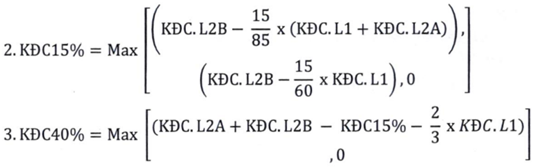
Where:
a) Level 1, Level 2A, Level 2B: The value of eligible Level 1, Level 2A, and Level 2B HQLA unadjusted after being multiplied by the relevant liquidity factors corresponding to the assets;
b) KĐC.L1, KĐC.L2A, KĐC.L2B: The value of eligible Level 1, Level 2A, and Level 2B HQLA adjusted after being multiplied by the relevant liquidity factors corresponding to the assets. In which, the adjusted value is determined as follows:
(i) The adjusted value of Level 1, Level 2A, and Level 2B assets is the value of eligible HQLA derived after fully unwinding any secured financial asset transactions or repo and reverse repo transactions maturing within 30 days that involve the exchange of any HQLA for such Level 1 (including cash), Level 2A, and Level 2B assets;
(ii) The bank must unwind both transactions to calculate the adjusted value in the following cases:
- If the collateral is a financial asset received from a secured credit extension transaction within 30 days and the bank exercises its rehypothecation right under an agreement with another counterparty maturing within 30 days;
- If the asset is received from a repo or reverse repo transaction within 30 days and is secured for the bank’s obligation to another counterparty maturing within 30 days;
c) In the absence of transactions requiring unwinding, the bank determines KĐC.L1 as Level 1, KĐC.L2A as Level 2A, and KĐC.L2B as Level 2B.
For example: How to perform the unwinding:
At the time of calculating the LCR, Bank A holds VND 100 billion in cash and previously executed a repo transaction (selling a Level 2A asset to Bank B and committing to repurchase it within the subsequent 30 days for VND 40 billion).
Unwinding means that at the time of calculating the LCR, Bank A must assume that it has fully executed those transactions (i.e., it has repurchased the Level 2A asset). Then, Bank A’s assets will include VND 60 billion in cash and VND 40 billion in Level 2A assets (obtained after performing the unwind). The KĐC.L1 and KĐC.L2A values for calculating the LCR will fall into two scenarios:
(i) If the Level 2A asset meets operational requirements to become eligible HQLA:
- KĐC.L1 = VND 60 billion;
- KĐC.L2A = VND 40 billion x 85% (the liquidity factor of Level 2A assets) = VND 34 billion.
Accordingly, KĐC.L1 of VND 60 billion and KĐC.L2A of VND 34 billion will be used to calculate the eligible HQLA value.
(ii) If the Level 2A asset does not meet operational requirements:
- KĐC.L1 = VND 60 billion;
- KĐC.L2A = 0 (since the Level 2A asset fails to meet operational requirements)
Accordingly, KĐC.L1 of VND 60 billion will be used to calculate the eligible HQLA value.
4. The undrawn capacity of a facility established on the basis of a Level 1 HQLA as collateral in transactions with the State Bank is included in the eligible HQLA value and is treated as a Level 1 asset.
5. For foreign bank branches, the undrawn committed facility from the parent bank shall be included in the stock of eligible HQLA, but shall not exceed 50% of the stock of eligible HQLA that the foreign bank branch is required to hold to comply with the LCR requirement, provided that the following requirements are met:
a) For a committed facility reciprocally backed by a portfolio of the parent bank’s Level 1 HQLA, the foreign bank branch may be considered for inclusion in the stock of eligible HQLA where the following requirements are met:
(i) The country in which the parent bank is headquartered has implemented the LCR, and the parent bank is required to comply with such LCR;
(ii) The parent bank’s LCR as reported to its supervisory in accordance with law exceeds the minimum requirement of the country in which the parent bank is headquartered as at the most recent date prior to the date on which the foreign bank branch’s LCR is calculated, and the projected LCR after providing support to the foreign bank branch under the committed facility continues to comply with the principle prescribed in Clause 3, Article 17 of this Circular;
(iii) The parent bank must earmark a portfolio of its Level 1 HQLA solely for the purpose of providing liquidity to the foreign bank branch in Vietnam, in an amount corresponding to the committed facility;
(iv) The parent bank must have internal policies on the operation, handling and conversion of the committed Level 1 HQLA portfolio, or other necessary measures, to provide immediate liquidity support to the foreign bank branch in Vietnam within a maximum of 01 working day (24 hours) from the time the foreign bank branch breaches the LCR requirement in Vietnam;
b) For an irrevocable committed facility that is not backed by a portfolio of the parent bank’s Level 1 HQLA, the foreign bank branch may include it in the stock of eligible HQLA, but not exceeding 40% of the stock of eligible HQLA that the foreign bank branch is required to hold to comply with the LCR requirement, where the requirements prescribed at Point a(i), Point a(ii) and Point a(iv) of this Clause are met;
c) The committed facility prescribed at Points a and b of this Clause must be documented in a written agreement between the 02 parties and be legally enforceable in all relevant jurisdictions. The agreement must specify the amount of the committed facility (including the details prescribed at Point a(iii) of this Clause, where applicable).
Based on the results of examination, inspection and supervision, where the State Bank assesses that the parent bank’s capacity and level of support for the branch in Vietnam are inadequate, on the basis of the history of liquidity support or information on the parent bank’s operations (if any), the State Bank may reduce this cap to a lower level or cease to permit the parent bank’s committed facility to be included in the stock of eligible HQLA;
d) The foreign bank branch must report the following in accordance with Clause 5, Article 4 of this Circular:
(i) The parent bank’s LCR prescribed at Point a(ii) of this Clause as at the LCR reporting dates prescribed in this Circular;
(ii) The legal and regulatory regulations on the LCR in the country in which the parent bank is headquartered, as prescribed at Point a(i) of this Clause, and the provisions on reporting dates prescribed at Point a(ii) of this Clause, upon commencement of LCR implementation under this Circular or within 20 days of any change in the relevant legal regulations affecting the conditions prescribed at Point a of this Clause;
(iii) The internal policies prescribed at Point a(iv) of this Clause and the agreement prescribed at Point c of this Clause, upon commencement of LCR implementation under this Circular or within 10 days of any change in the internal policies relating to Point a(iv) of this Clause or in the agreement prescribed at Point c of this Clause.
6. When calculating the LCR, banks shall apply the principles prescribed at Point b, Clause 5, Article 22 of this Circular.
II. Level 1 assets
1. Level 1 assets mean the assets prescribed in Clause 3 of this Section. Eligible Level 1 HQLA are not subject to any limit when calculating the stock of eligible HQLA and are assigned a liquidity factor of 100%, unless otherwise prescribed in Clause 2 of this Section.
2. Based on the results of examination, inspection and supervision, where the State Bank assesses that a bank’s eligible HQLA do not adequately reflect their actual level of risk, the State Bank of Vietnam may require the bank to apply a lower liquidity factor based on one or more of the following criteria: The sensitivity of the assets to interest rate risk, market risk, credit risk and liquidity risk, and typical haircuts in the repo market.
3. Level 1 assets comprise:
a) Cash;
b) Deposits (including required reserves) held with the State Bank;
c) Securities that satisfy all of the following conditions:
(i) Securities issued or guaranteed by the following entities:
- Governments, central banks, and public sector entities (PSEs) of countries other than Vietnam;
- The Bank for International Settlements (BIS);
- The International Monetary Fund (IMF);
- The European Central Bank (ECB) and the European Community;
- The European Stability Mechanism (ESM);
- The European Financial Stability Facility (EFSF) or international financial institutions;
(ii) Assigned a 0% risk weight under the standardized approach prescribed in Circular No. 14/2025/TT-NHNN or under the provisions of Circular No. 41/2016/TT-NHNN that the bank is currently applying (hereinafter collectively referred to as the standardized approach);
(iii) Being securities eligible for listing and currently listed on a trading exchange in accordance with law;
(iv) Having a market history of 10 years (or the maximum period for which market data is available if less than 10 years) with a maximum price decline not exceeding 5% or a maximum increase in haircut not exceeding 5% over a 30-day period of significant market stress;
(v) Not issued by a financial institution or by its parent company, subsidiaries or affiliates;
d) Debt instruments of the Government of Vietnam (including Vietnamese Government bonds and State Treasury bills), and State Bank bills, denominated in VND;
dd) Debt instruments of the Government of Vietnam and State Bank bills, denominated in foreign currencies;
e) Bonds guaranteed by the Government for 100% of principal and interest at maturity; local government bonds used in transactions with the State Bank as decided by the State Bank Governor from time to time;
g) Assets in the HQLA portfolio of an overseas branch of a commercial bank that meet the conditions for eligible Level 1 HQLA under this Circular;
h) Debt instruments of the Government (including government bonds) and of the central bank of the country where the commercial bank’s overseas branch is located, and which are included in that overseas branch’s HQLA portfolio, unless otherwise prescribed at Point g of this Clause. The total amount of these debt instruments included in eligible Level 1 HQLA shall not exceed the net cash outflows of such overseas branch.
III. Level 2A assets
1. Level 2A assets mean the assets prescribed in Clause 3 of this Section. Eligible Level 2A HQLA are subject to a liquidity factor of 85% when calculating the stock of eligible HQLA, unless otherwise prescribed in Clause 2 of this Section.
2. The State Bank may require a bank to apply a lower liquidity factor as prescribed in Clause 2, Section II of this Part.
3. Level 2A assets comprise:
a) Securities of foreign Governments, central banks, public sector entities, or international financial institutions, or securities guaranteed by these entities, satisfying all the following conditions:
(i) Assigned a maximum risk weight of 20% under the standardized approach;
(ii) Being securities eligible for listing and currently listed on a trading exchange in accordance with law;
(iii) Having a market history of 10 years (or the maximum period for which market data is available if less than 10 years) with a maximum price decline not exceeding 10% or a maximum increase in haircut not exceeding 10% over a 30-day period of significant market stress;
(iv) Not issued by a financial institution or by its parent company, subsidiaries or affiliates;
b) Corporate debt securities satisfying all the following conditions:
(i) Not issued by a financial institution or by its parent company, subsidiaries or affiliates;
(ii) Rated AA- or higher by an independent credit rating agency;
(iii) Being securities eligible for listing and currently listed on a trading exchange in accordance with law;
(iv) Having a market history of 10 years (or the maximum period for which market data is available if less than 10 years) with a maximum price decline not exceeding 10% or a maximum increase in haircut not exceeding 10% over a 30-day period of significant market stress;
c) Assets in the HQLA portfolio of overseas branches of commercial banks that meet the conditions of eligible Level 2A HQLA under this Circular.
IV. Level 2B assets
1. Level 2B assets mean the assets prescribed in Clause 3 of this Section. Eligible Level 2B HQLA are subject to the liquidity factor applicable to each type of asset when calculating the stock of eligible HQLA.
2. The State Bank may require a bank to apply a lower liquidity factor in accordance with Clause 2, Section II of this Part, or may disallow the inclusion of such assets in eligible Level 2B HQLA.
3. Level 2B assets comprise:
a) Residential mortgage-backed securities (RMBS), subject to a liquidity factor of 75%, that satisfy all of the following conditions:
(i) Not issued by the bank itself or by its parent company, subsidiaries or affiliates;
(ii) The underlying residential mortgage claims have not been originated by the bank or by its parent company, subsidiaries or affiliated entities;
(iii) Rated AA or higher by an independent credit rating agency;
(iv) Being securities eligible for listing and currently listed on a trading exchange in accordance with law;
(v) Having a market history of 10 years (or the maximum period for which market data is available if less than 10 years) with a maximum price decline not exceeding 20% or a maximum increase in haircut not exceeding 20% over a 30-day period of significant market stress;
(vi) The underlying asset pools must be restricted to residential mortgages and must not contain structured products;
(vii) The underlying residential mortgages must be full recourse loans (i.e. in the case of foreclosure, the borrower remains liable for any shortfall in the proceeds from the sale of the collateral relative to the borrower’s debt obligations) and have a maximum loan-to-value (LTV) ratio of 80% on average at issuance;
(viii) The securitizations must be subject to legal regulations of the country that securitizes;
b) Corporate debt securities subject to a liquidity factor of 50% that satisfy all the following conditions:
(i) Not issued by a financial institution or by its parent company, subsidiaries or affiliates;
(ii) Rated BBB- or higher by an independent credit rating agency;
(iii) Being securities eligible for listing and currently listed on a trading exchange in accordance with law;
(iv) Having a market history of 10 years (or the maximum period for which market data is available if less than 10 years) with a maximum price decline not exceeding 20% or a maximum increase in haircut not exceeding 20% over a 30-day period of significant market stress;
c) Securities of foreign Governments, central banks, public sector entities, or international financial institutions subject to a liquidity factor of 50%, excluding securities that already qualify as Level 1 and Level 2A assets, which satisfy all the following conditions:
(i) Rated BBB- or higher by an independent credit rating agency and assigned a maximum risk weight of 50% under the standardized approach;
(ii) Being securities eligible for listing and currently listed on a trading exchange in accordance with law;
(iii) Having a market history of 10 years (or the maximum period for which market data is available if less than 10 years) with a maximum price decline not exceeding 20% or a maximum increase in haircut not exceeding 20% over a 30-day period of significant market stress;
(iv) Not issued by a financial institution or by its parent company, subsidiaries or affiliates;
d) Common equity shares subject to a liquidity factor of 50% that satisfy all the following conditions:
(i) Not issued by a financial institution or by its parent company, subsidiaries or affiliates;
(ii) Being a constituent of the VN30 stock index or a major stock index as determined by the competent state authority in the country where the bank is exposed to liquidity risk;
(iii) Denominated in VND or in the currency of the country where the bank is exposed to liquidity risk;
(iv) Being securities eligible for listing, currently listed on a trading exchange in accordance with law, and centrally cleared;
(v) Having a market history of 10 years (or the maximum period for which market data is available if less than 10 years) with a maximum price decline not exceeding 40% or a maximum increase in haircut not exceeding 40% over a 30-day period of significant market stress;
dd) Assets in the HQLA portfolio of an overseas branch of a commercial bank that meet the conditions for eligible Level 2B HQLA under this Circular.
V. “Eligible HQLA” calculation table
Section | Types of assets | Balance | Adjusted value | Liquidity factor | Value multiplied by the liquidity factor | Adjusted value multiplied by the liquidity factor | Guidelines in this Appendix |
(1) | (2) | (3) | (4)=(1)x(3) | (5)=(2)x(3) | |||
1 | Level 1 assets = ∑(1.1÷1.7) |
|
|
| Level 1 | KĐC.L1 |
|
1.1. | Cash |
|
| 100% |
|
| Point 3a Section II Part A |
1.2. | Deposits (including required reserves) held with the State Bank |
|
| 100% |
|
| Point 3b Section II Part A |
1.3. | Eligible securities of Governments, central banks of other countries, public sector entities, and international financial institutions, and securities guaranteed by these entities. |
|
| 100% |
|
| Point 3c Section II Part A |
1.4. | Debt instruments, bonds of the Vietnamese Government or the State Bank = (1.4.1) + (1.4.2) |
|
|
|
|
|
|
1.4.1. | Debt instruments denominated in VND |
|
| 100% |
|
| Point 3d Section II Part A |
1.4.2. | Debt instruments denominated in foreign currencies |
|
| 100% |
|
| Point 3dd Section II Part A |
1.5. | Bonds guaranteed by the Government for 100% of principal and interest at maturity; local government bonds |
|
| 100% |
|
| Point 3e Section II Part A |
1.6. | Assets in the HQLA portfolio of overseas branches of the commercial bank |
|
| 100% |
|
| Point 3g Section II Part A |
1.7. | Debt instruments and bonds of the Government and central bank of the country where the overseas branch of the commercial bank is headquartered |
|
| 100% |
|
| Point 3h Section II Part A |
2 | Level 2 assets |
|
|
|
|
|
|
2.1. | Level 2A assets = ∑(2.1.1÷2.1.3) |
|
|
| Level 2A | KĐC.L2A |
|
2.1.1. | Eligible securities of Governments, central banks, international financial institutions, and public sector entities with a maximum risk weight of 20%, and securities guaranteed by these entities. |
|
| 85% |
|
| Point 3a Section III Part A |
2.1.2. | Debt securities of eligible enterprises rated AA- or higher |
|
| 85% |
|
| Point 3b Section III Part A |
2.1.3. | Assets in the HQLA portfolio of overseas branches of the commercial bank |
|
| 85% |
|
| Point 3c Section III Part A |
2.2. | Level 2B assets = ∑(2.2.1÷2.2.5) |
|
|
| Level 2B | KĐC.L2B |
|
2.2.1. | Eligible residential mortgage-backed securities (RMBS) |
|
| 75% |
|
| Point 3a Section IV Part A |
2.2.2. | Debt securities of eligible enterprises rated BBB- or higher |
|
| 50% |
|
| Point 3b Section IV Part A |
2.2.3. | Eligible securities of Governments, central banks, and public sector entities or international financial institutions rated BBB- or higher, not qualifying as Level 1 or Level 2A assets |
|
| 50% |
|
| Point 3c Section IV Part A
|
2.2.4. | Eligible common equity shares |
|
| 50% |
|
| Point 3d Section IV Part A |
2.2.5. | Assets in the HQLA portfolio of overseas branches of the commercial bank |
|
| By specific type |
|
| Point 3dd Section IV Part A |
3 | KĐC15% |
|
|
|
|
| Point 2 Section I Part A |
4 | KĐC40% |
|
|
|
|
| Point 3 Section I Part A |
5 | Facility = (5.1) + (5.2) |
|
|
|
|
|
|
5.1. | Undrawn capacity of the facility established in transactions with the State Bank |
|
|
|
|
| Point 4 Section I Part A |
5.2. | Undrawn capacity of the facility from the parent bank (for foreign bank branches) = (5.2.1) + (5.2.2) |
|
|
|
|
| Point 5 Section I Part A |
5.2.1. | Committed facility reciprocally backed by a Level 1 HQLA portfolio |
|
|
|
|
| Point 5a Section I Part A |
5.2.2. | Irrevocable committed facility not reciprocally backed by a Level 1 HQLA portfolio of the parent bank |
|
|
|
|
| Point 5b Section I Part A |
Stock of eligible HQLA = Level 1 + Level 2A + Level 2B + Limit (Item 5 of this Table) – KĐC15% (Item 3 of this Table) – KĐC40% (Item 4 of this Table) | |||||||
Column (1) is the eligible balance as prescribed in this Appendix and this Circular, determined on a mark-to-market basis or calculated via a mark-to-model valuation. In the case of valuable papers traded with the State Bank, it is the lowest transaction value determined according to the State Bank’s regulations.
Column (2) is the adjusted value after fully unwinding transactions.
PART B. CASH OUTFLOW
I. General principles
1. Total cash outflow means the sum of cash flows arising from obligations due for payment, commitments to be fulfilled, or obligations expected to arise within the subsequent 30 days of the bank.
2. In case the timing of the performance of an obligation or commitment cannot be determined, and funding has a remaining maturity of more than 30 days as prescribed at Point b, Clause 4 of this Section, the amount required to settle such obligation or commitment must be included in “Cash Outflow” of the “Subsequent Day”.
3. Past-due obligations to be fulfilled must be included in the “Cash Outflow” of the “Subsequent Day” (including interest amounts, past-due interest, and penalty interest on late payment (if any)).
4. For funding mobilized from clients with a remaining maturity exceeding the subsequent 30 days at the time of calculating the LCR, the bank shall apply the following:
a) Funding is not required to be included in cash outflows when:
(i) The client has no right to withdraw funds early under the agreement (including cases where the client’s financial assets are encumbered) for a period longer than 30 days from the time of calculating the LCR;
(ii) The client has the right to withdraw funds early, and the required advance notice period for withdrawal is longer than 30 days under the agreement, but the client has not given a withdrawal notice by the time of calculating the LCR, or the client has given a withdrawal notice but the remaining time to the expected withdrawal date is longer than 30 days from the time of calculating the LCR;
(iii) The client has the right to early withdrawal of VND retail deposits (including wholesale deposits treated as retail deposits), but the client is only subject to a maximum interest rate equal to the bank’s lowest VND demand deposit interest rate for that client segment at the time of early withdrawal, and is not entitled to other benefits (if any) arising from the client’s deposit funds;
(iv) The client has the right to early withdrawal of wholesale funding (excluding wholesale deposits treated as retail deposits) when the bank breaches agreed obligations, but the client has not given a withdrawal notice by the time of calculating the LCR, or the client has given a withdrawal notice but the remaining time to the expected withdrawal date is longer than 30 days from the time of calculating the LCR.
b) Funding is required to be included in cash outflows when:
(i) A client has a contractual right to withdraw funds within the subsequent 30 days from the time of calculating the LCR, unless otherwise prescribed at Point a(ii), a(iii), and a(iv) of this Clause;
(ii) There is no information or insufficient conditions to classify the maturity-based funding source prescribed at Point a of this Clause;
(iii) The bank has the right to buy back or prepay funding sources, and the bank has issued a notice of buyback or prepayment with a remaining time to the expected payment date within 30 days from the time of calculating the LCR;
(iv) If the bank fails to execute early payment per inspection or examination conclusions, the bank must include the entire remaining amount subject to early payment up to the time of calculating the LCR into the “Cash Outflow” of the “Subsequent Day.”
II. Retail deposits
1. General regulations on retail deposits
1.1. Definition
a) Retail deposits mean deposits of retail clients;
b) Retail clients include individuals, cooperative groups, and household businesses (excluding private enterprises and other organizations without legal personality) at a bank.
1.2. Classification of retail deposits for LCR calculation
a) Deposits included in the LCR calculation are classified into stable deposits and less stable deposits;
b) The run-off factors for stable deposits and less stable deposits are determined respectively in accordance with Clause 2 and Clause 3 of this Section.
1.3. Foreign currency retail deposits
Foreign currency retail deposits mean deposits in any currency other than VND. Foreign currency deposits are treated as less stable retail deposits.
2. Stable retail deposits
2.1. General principles
a) Stable retail deposits mean deposits fully covered by the Deposit Insurance of Vietnam and satisfy one of the following two conditions:
(i) The client has a medium- or long-term loan with the bank;
(ii) The client has a deposit (excluding required minimum balances) maintained in a payment account at the bank and has engaged in payment activities (excluding the bank’s automated fee collection activities) within the last 06 months;
b) “Fully covered by insurance” means 100% of the deposit amount falls within the deposit insurance coverage. The deposit balance exceeding the insurance coverage is treated as less stable deposits.
2.2. Run-off factor
For stable deposits meeting the conditions prescribed in Clause 2.1 of this Section, the run-off factor is 5%.
3. Less stable retail deposits
3.1. Less stable retail deposits mean deposits not classified as stable deposits prescribed in Clause 2 of this Section.
3.2. The run-off factor for less stable retail deposits is 10%.
3.3. During stress testing, a bank must divide less stable deposits into buckets with similar risk characteristics to determine different run-off factors corresponding to the characteristics and behaviors of each client bucket in accordance with the bank’s internal regulations.
III. Wholesale funding
1. General principles
Wholesale funding includes liabilities (including deposits) and payment obligations raised from legal entities, private enterprises, partnerships, or other organizations without legal entity status under the law, and funding not classified as retail deposits.
2. Unsecured wholesale funding
2.1. Identification of unsecured wholesale funding
a) Unsecured wholesale funding is wholesale funding not classified as secured wholesale funding prescribed in Clause 3.1 of this Section;
b) Obligations related to derivative contracts are not unsecured wholesale funding;
c) Unsecured wholesale funding includes:
(i) Wholesale deposits from eligible small- and medium-sized enterprise clients;
(ii) Operational deposits generated by clearing, custody, and cash management activities;
(iii) Unsecured wholesale funding provided by enterprises and Governments, central banks, public sector entities, and international financial institutions;
(iv) Other unsecured funding.
2.2. Wholesale deposits from eligible small- and medium-sized enterprise clients
a) General principles
(i) Deposits from eligible small- and medium-sized enterprise clients are treated as retail deposits in accordance with this Appendix, including: Stable wholesale deposits and less stable wholesale deposits;
(ii) Stable wholesale deposits are deposits meeting the same conditions as stable retail deposits. Less stable wholesale deposits are deposits not classified as stable wholesale deposits;
(iii) The run-off factors applied to stable wholesale deposits and less stable wholesale deposits are identical to those applied to each corresponding type of retail deposit;
b) Identification of eligible small- and medium-sized enterprises
(i) An eligible small- and medium-sized enterprise is an enterprise satisfying all the following conditions:
- It is not a financial institution;
- It is a small and medium-sized enterprise determined in accordance with law on small and medium-sized enterprises;
- The total average deposit balance of this enterprise at the bank itself during the month immediately preceding the time of calculating the LCR does not exceed VND 30 billion;
(ii) To classify small- and medium-sized enterprises in the reporting month, the bank shall use the total average deposit balance during the month immediately preceding the time of calculating the LCR, which is the sum of the enterprise’s deposit balances at the end of each day in the preceding month divided by the total number of days in that month;
(iii) The bank must possess information to identify small- and medium-sized enterprises in accordance with law on small and medium-sized enterprises based on the client information required for each product or service under legal regulations, other information provided by the client as agreed, or other information sources (if any).
If there is no information to confirm an enterprise qualifies as a small- and medium-sized enterprise, the bank must not classify it as a small- and medium-sized enterprise.
2.3. Operational deposits generated by clearing, custody, and cash management activities
a) General provisions
(i) Operational deposits generated by clearing, custody, and cash management activities are deposits arising from the bank’s clearing, custody, and cash management services that require clients to place deposits, margins, or maintain balances at a bank (hereinafter referred to as operational deposits);
(ii) Operational deposits are subject to a run-off factor of 25%;
(iii) A bank may apply a run-off factor higher than 25% if operational deposits are concentrated among a few clients, causing concentration risk as per the bank’s internal regulations when conducting stress testing;
(iv) Amounts deposited, margined, or maintained at other banks for clearing, custody, and cash management purposes are subject to an inflow rate of 0%, unless otherwise prescribed at Point b, Clause 8, Section IV, Part C of this Appendix;
(v) Clearing means a service arrangement that enables clients to transfer funds (or securities) indirectly through direct participants in domestic settlement systems to final recipients. The scope of clearing complies with legal regulations and is limited to one or more of the following activities:
- Transmission, reconciliation, and confirmation of payment orders;
- Provision of intraday overdrafts, overnight financing, and maintenance of post-settlement balances;
- Determination of intraday and final settlement positions;
(vi) Custody means the provision of safekeeping, reporting, and processing of assets, or the facilitation of operational and administrative elements related to clients’ financial transactions. The scope of custody complies with legal regulations and is limited to one or more of the following activities:
- Settlement of securities transactions;
- Transfer of contractual payments;
- Processing of collateral;
- Provision of custody-related cash management services;
- Receipt of dividends and other income, client subscriptions and redemptions;
(vii) Cash management means the provision of products and services to clients to manage their cash flows, assets, and liabilities, and to execute financial transactions necessary for their ongoing operations. The scope of cash management complies with legal regulations and is limited to one or more of the following activities:
- Payment remittance;
- Collection and aggregation of funds;
- Payroll administration;
- Control over the disbursement of funds;
(viii) Operational deposits that are fully covered (if any) by deposit insurance shall be assigned a run-off factor equivalent to that of stable retail deposits;
b) Conditions for deposits in clearing, custody, and cash management activities to be classified as operational deposits
(i) A bank must carry out clearing, custody, and cash management activities in accordance with law;
(ii) Clients must use the products and services provided by the bank to meet their normal operational needs over the next 30 days;
(iii) The products and services must be provided under an agreement between the bank and a client, including provisions requiring the client to place deposits, margins, or maintain balances at the bank to use a specific product or service;
(iv) Termination of the agreement must be subject to either of the following conditions:
- A notice period of more than 30 days prior to the intended termination date;
- The client would incur significant switching costs (including transaction, information technology, early termination, or legal costs) if they withdraw the operational deposits within 30 days of the withdrawal notice. These costs, explicitly stated in the agreement between the bank and the client, must be at least equal to all interest earned on the operational deposits plus 10% of the principal amount of the operational deposits;
(v) They are not deposits generated from correspondent banking.
Correspondent banking means an arrangement where a correspondent bank in one country or territory receives deposits from a respondent bank in another country or territory to provide payment and other services for executing foreign exchange transactions for the respondent bank.
c) Conditions for operational deposits
(i) A qualifying operational deposit is a deposit meeting the following conditions:
- The deposit is the byproduct of the underlying products and services provided by the bank to the client, and not sought out in the wholesale market merely for interest income;
- The deposit is held in specifically designated accounts and is priced at the bank’s lowest demand deposit interest rate;
(ii) The bank and the client must agree on the minimum deposit balance that must be maintained;
(iii) The deposit-taking bank must not apply the 25% run-off factor to the excess operational deposit balance beyond the amount required by product policy and the agreement between the bank and the client. If the deposit-taking bank is unable to determine the excess balance, the entire deposit amount is deemed ineligible and cannot be assigned the 25% run-off factor.
2.4. Unsecured wholesale funding provided by enterprises and Governments, central banks, public sector entities (PSEs), and international financial institutions
a) Determining the scope:
(i) Funding from enterprises (excluding eligible small- and medium-sized enterprises and financial institutions);
(ii) Funding from Governments, foreign Governments, the State Bank, foreign central banks; international financial institutions; foreign public sector entities, the State Treasury, People’s Committees of provinces and centrally-run cities, policy banks, Deposit Insurance of Vietnam, Vietnam Social Security;
(iii) This funding excludes operational deposits;
b) For funding prescribed at Point a of this Clause, the run-off factor is 40%.
2.5. Other unsecured funding
a) Other unsecured funding means funding not classified into Clauses 2.2, 2.3, and 2.4 of this Section;
b) The run-off factor is 100%.
3. Secured wholesale funding
3.1. Identification of secured wholesale funding
Secured wholesale funding means funding that satisfies the following conditions:
a) Wholesale funding that is collateralized by assets owned by the bank (including repo transactions), even in cases of bankruptcy, insolvency, liquidation, or restructuring;
b) The collateral must be a financial asset, except when the counterparty is the State Bank, in which case the collateral follows the State Bank’s regulations.
3.2. Types of secured wholesale funding
3.2.1. General principles
a) The run-off factors in Clause 3.2.2 of this Section apply to secured wholesale funding outstanding at the time of calculating the LCR;
b) In case the bank commits a pool of collateral to secure both transactions with a remaining maturity of more than 30 days and those under 30 days, and it is impossible to determine exactly which assets secure which transactions, the bank shall assume that assets assigned the highest run-off factors for LCR calculation are applied first to the transactions with the shortest maturities.
3.2.2. Types of secured wholesale funding and run-off factors
Types of secured wholesale funding | Run-off factor |
a) Funding backed by Level 1 HQLA or in transactions with the State Bank | 0% |
b) Funding backed by Level 2A HQLA | 15% |
c) Funding backed by financial assets other than Level 1 or Level 2A HQLA in transactions with the Government, State Treasury, People’s Committees of provinces and centrally-run cities, policy banks, Vietnam Asset Management Company, Vietnam Debt Trading Company Limited, Deposit Insurance of Vietnam, Vietnam Social Security, or international financial institutions | 25% |
d) Funding backed by eligible residential mortgage-backed securities (RMBS) qualifying as Level 2B HQLA | 25% |
dd) Funding backed by other Level 2B HQLA | 50% |
e) Funding backed by other financial assets | 100% |
IV. Cash outflows with additional requirements
1. Net cash outflows from derivative contracts
1.1. Principles for calculating cash outflows from derivative transactions
a) A bank must calculate cash inflows and outflows under agreements in compliance with the law.
(i) Cash flows are calculated on a net basis (i.e., inflows can offset outflows) by counterparty only when an eligible bilateral netting agreement exists;
(ii) The bank must not include in these calculations liquidity requirements arising from increased collateral needs due to market price fluctuations or a decline in the value of posted collateral;
b) When calculating the VND-equivalent LCR, for a client’s foreign exchange derivative transaction where the bank and the client settle all obligations with each other on the same day as agreed, the bank may net the cash flows to determine the net cash flow value even without an eligible bilateral netting agreement;
c) If the settlement of a derivative transaction is collateralized by eligible HQLA and the bank has the right to rehypothecate this collateral to raise cash, the cash outflow for that derivative transaction is determined as the cash outflow net of the cash received or the value of the eligible HQLA multiplied by its corresponding liquidity factor;
d) Cash outflows from derivative transactions not in the cases prescribed at Points a, b, and c of this Clause are determined as the gross cash outflows of each such transaction.
1.2. The run-off factor for cash outflows in Clause 1.1 of this Section is 100%.
1.3. Options that can be exercised within the subsequent 30 days (including options with a maturity longer than 30 days but exercisable within 30 days) must be assumed to be exercised when they are in the money to the option buyers.
1.4. For transactions involving the delivery of financial assets where a choice of multiple assets exists, a bank must assume that the cheapest-to-deliver asset will be used for settlement and apply the corresponding HQLA liquidity factor or a 25% liquidity factor for non-HQLA financial assets.
This rule must be applied symmetrically to both inflows and outflows (the party obligated to pay is assumed to deliver the cheapest-to-deliver asset), unless the parties have agreed to deliver a specific asset.
If the agreement permits both physical delivery and cash settlement, it can be assumed the option will be cash-settled.
2. Requirement to calculate additional cash outflows
2.1. Additional cash outflows upon credit rating downgrade
a) It applies to transactions containing terms and conditions requiring the posting of additional collateral, the drawdown of contingent credit lines, early repayment, or similar clauses triggered when the bank (including the parent bank of a foreign bank branch) is downgraded by an independent credit rating agency;
b) A bank must include 100% of the value required to be posted for a downgrade of up to three notches in the cash outflows. The bank must assess the impact of the downgrade on posted collateral and contractual clauses altering rehypothecation rights for non-segregated collateral.
2.2. Additional cash outflows related to potential changes in the value of collateral posted to secure derivative and other transactions
a) It applies to transactions requiring margin where collateral value fluctuates based on mark-to-market or mark-to-model valuations, and the bank uses financial assets other than Level 1 HQLA as collateral;
b) The bank must add 20% of the value of all such collateral to its cash outflows, net of the value of collateral received from the counterparty (provided that the received collateral is unencumbered and does not arise from the counterparty exercising rehypothecation rights).
(i) Value of collateral = Notional amount of the collateral x Liquidity factor of the collateral.
In which, the liquidity factor of the collateral is determined as follows:
- For Level 2 HQLA: The liquidity factor of the collateral equals the liquidity factor of eligible Level 2 HQLA in Section III and Section IV, Part A of this Appendix;
- For other financial assets: The liquidity factor of the collateral is 25%;
(ii) If the collateral is recorded and tracked in a segregated margin account, cash outflows can only be netted against permitted payments within that same account, and no other forms of netting (e.g., netting collateral flows across counterparties) are allowed.
2.3. Additional cash outflows related to excess non-segregated collateral held by the bank that can be contractually recalled by the counterparty
a) It applies to secured transactions where excess non-segregated collateral is included in the bank’s HQLA portfolio and can be recalled by the counterparty at any time under the agreement;
b) A bank must add 100% of the value of the excess non-segregated collateral to its cash outflows.
2.4. Additional cash outflows related to contractually required collateral that the counterparty has not yet called
A bank must add 100% of the value of collateral contractually required to be posted, but which the counterparty has not yet called for, to its cash outflows.
2.5. Additional cash outflows related to market valuation changes on derivative or other transactions
a) It applies to transactions requiring collateralization for mark-to-market or mark-to-model valuation differences;
b) A bank must:
(i) Without an eligible bilateral netting agreement: Add 100% of the payable obligation value upon revaluation to the cash outflows;
(ii) With an eligible bilateral netting agreement:
- Calculate on a net basis between the payable obligation value and the receivable asset value;
- Determine the absolute value of the largest 30-day net margin cash flow occurring within the preceding 24 months based on realized net cash outflows and realized net cash inflows at the portfolio-level;
- Add 100% of the absolute value of the largest 30-day net margin cash flow occurring within the preceding 24 months to the cash outflows;
(iii) In the case prescribed at Point b(ii) of this Clause, the bank must perform this at the portfolio-level when calculating the LCR, but must monitor and manage net margin cash flows at the counterparty level in accordance with its internal regulations.
V. Cash outflows from off-balance sheet commitments
1. Scope of cash outflows from committed facilities
1.1. Committed facilities (including credit facilities and liquidity facilities) mean irrevocable or conditionally revocable agreements to provide funds at a future date to clients, where the clients have the right, but are not obliged, to draw down funds within the subsequent 30 days.
Unconditionally revocable committed facilities are subject to Clause 3 of this Section.
1.2. The off-balance-sheet commitment value is the undrawn and undisbursed portion of the committed facility, minus the client’s cash collateral or the portion of eligible HQLA whose ownership has been transferred by the client to the bank, after multiplying by the liquidity factor, if such eligible HQLA has not been included in the stock of eligible HQLA.
1.3. Liquidity facilities mean facility commitments to pay clients’ existing debt obligations maturing within 30 days when the clients are unable to continue rolling over such debt obligations.
The remaining portion of a liquidity facility that is not used to pay an existing debt obligation of the client is treated as a credit facility and is subject to the run-off factor prescribed in Clause 1.5 of this Section.
1.4. Credit facilities means the undrawn and undisbursed portions of the committed facilities of credit cards, credit extension facilities (except bank guarantees) and other committed facilities that have not been drawn or used in line with the purpose agreed between the clients and the banks, except for liquidity facilities prescribed in Clause 1.3 of this Section.
1.5. The run-off factors of committed facilities are determined as follows:
Subjects | Run-off factor | |
Credit facilities | Liquidity facilities | |
a) Individuals and eligible small- and medium-sized enterprises | 5% | 5% |
b) Enterprises that are not financial institutions | 10% | 30% |
c) Governments, foreign Governments, central banks, public sector entities of foreign Governments; the State Treasury, People’s Committees of provinces and centrally-run cities, Deposit Insurance of Vietnam; international financial institutions | 10% | 30% |
d) Credit institutions and foreign bank branches | 40% | 40% |
dd) Other financial institutions that are not credit institutions or foreign bank branches | 40% | 100% |
e) Other entities not prescribed at Points a, b, c, d and dd of this Clause | 100% | 100% |
2. Cash outflows from obligations to disburse or pay under agreements
2.1. For obligations under agreements to disburse or pay within the subsequent 30 days to financial institutions (including the State Bank), the run-off factor is 100%.
2.2. For obligations under agreements to disburse or pay within the subsequent 30 days to individuals and other entities (excluding financial institutions), in case the total value of obligations to disburse or pay within the subsequent 30 days exceeds 50% of the total value of cash inflows in the subsequent 30 days from these client groups, the entire positive difference shall be recorded as cash outflows.
3. Cash outflows from other contingent funding obligations
3.1. Other contractual or non-contractual contingent funding obligations, arising upon a credit event or other events that may not be related to liquidity events but may still cause cash outflows, which are not the items prescribed in Clauses 1 and 2 of this Section, include:
a) Contractual contingent funding obligations mean obligations that a bank is responsible for performing under an agreement, but disbursement of funds only occurs when a specific future event (contingency) arises, and such agreements comply with the law, including:
(i) Unconditionally revocable committed facilities;
(ii) Trade finance instruments, which are obligations directly related to the movement of goods and the provision of services (such as documentary collections, import bills and export bills; shipping guarantees);
(iii) Off-balance-sheet commitments of bank guarantee operations, bid guarantees and performance guarantees, except trade finance instruments at Point a(ii) of this Clause;
(iv) Commitments to provide another off-balance-sheet commitment that is used in line with the client’s purpose as agreed with the bank;
(v) Autocallable notes and funding instruments with maturity mechanisms based on market trigger thresholds (issued by the bank);
b) Non-contractual contingent funding obligations are obligations that do not arise from written commitments but for which the bank may still need to provide financial support to protect its reputation or to maintain the bank’s joint venture, capital contribution and investment activities;
c) Other off-balance-sheet commitments.
3.2. Run-off factor
a) For obligations prescribed at Points a(i) and a(iv), Clause 3.1 of this Section, the run-off factor is 0%;
b) For obligations prescribed at Point a(ii), Clause 3.1 of this Section, the run-off factor is 3%;
c) For obligations prescribed at Points a(iii) and a(v), Clause 3.1 of this Section, the run-off factor is 5%;
d) For obligations prescribed at Points b and c, Clause 3.1 of this Section, the run-off factor is determined by the bank based on historical data for each type of obligation and other relevant legal events.
3.3. In case a contingent funding obligation arises from specific events that trigger the contract under the agreement and one of the relevant parties under the agreement requests payment within the subsequent 30 days, the run-off factor is 100%.
VI. Other contractual cash outflows
1. Any other cash outflows not prescribed in Sections II, III, IV and V of this Part, for which a bank is obliged to perform under an agreement within the subsequent 30 days, must be included in cash outflows in accordance with this Circular.
2. The run-off factor is 100%.
VII. “Cash outflows” calculation table
Section | Cash outflow | Cash flow value by time to maturity | Run-off factor | Cash outflow value determined by risk level | Guidelines in this Appendix | ||||
Subsequent day | From 2nd day to 7th day | From 8th day to 14th day | From 15th day to 30th day | Total cash outflow value | |||||
(1) | (2) | (3) | (4) | (5)=∑[(1)÷(4)] | (6) | (7)=(5)x(6) | |||
1 | Retail deposits |
|
|
|
|
|
|
|
|
1.1. | Stable deposits |
|
|
|
|
| 5% |
| Clause 2 Section II Part B |
1.2. | Less stable deposits |
|
|
|
|
| 10% |
| Clause 3 Section II Part B |
2 | Unsecured wholesale funding |
|
|
|
|
|
|
|
|
2.1. | Deposits from eligible small- and medium-sized enterprise clients |
|
|
|
|
|
|
|
|
2.1.1. | Stable deposits |
|
|
|
|
| 5% |
| Clause 2.2 Section III Part B and Clause 2 Section II Part B |
2.1.2. | Less stable deposits |
|
|
|
|
| 10% |
| Clause 2.2 Section III Part B and Clause 3 Section II Part B |
2.2. | Operational deposits |
|
|
|
|
| 25% |
| Clause 2.3 Section III Part B |
2.3. | Funding from enterprises and Governments, central banks, public sector entities, and international financial institutions |
|
|
|
|
| 40% |
| Clause 2.4 Section III Part B |
2.4. | Other unsecured funding |
|
|
|
|
| 100% |
| Clause 2.5 Section III Part B |
3 | Secured wholesale funding |
|
|
|
|
|
|
|
|
3.1. | Funding backed by Level 1 HQLA or in transactions with the State Bank |
|
|
|
|
| 0% |
| Clause 3.2.2a Section III Part B |
3.2. | Funding backed by Level 2A HQLA |
|
|
|
|
| 15% |
| Clause 3.2.2b Section III Part B |
3.3. | Funding backed by other financial assets in transactions with the Government, the State Treasury, etc. |
|
|
|
|
| 25% |
| Clause 3.2.2c Section III Part B |
3.4. | Funding backed by eligible residential mortgage-backed securities (RMBS) qualifying as Level 2B |
|
|
|
|
| 25% |
| Clause 3.2.2d Section III Part B |
3.5. | Funding backed by other Level 2B HQLA |
|
|
|
|
| 50% |
| Clause 3.2.2dd Section III Part B |
3.6. | Funding backed by other financial assets |
|
|
|
|
| 100% |
| Clause 3.2.2e Section III Part B |
4 | Additional requirements |
|
|
|
|
|
|
|
|
4.1. | Liquidity demand due to potential changes in the value of collateral |
|
|
|
|
| 20% |
| Clause 2.2 Section IV Part B |
4.2. | Additional cash outflows upon credit rating downgrade |
|
|
|
|
|
100% |
| Clause 2.1 Section IV Part B |
4.3. | Additional cash outflows due to the counterparty’s right to call back under the agreement |
|
|
|
|
| 100% |
| Clause 2.3 Section IV Part B |
4.4. | Additional cash outflows due to required margin posting under the agreement where the counterparty has not yet called for margin |
|
|
|
|
| 100% |
| Clause 2.4 Section IV Part B |
4.5. | Additional cash outflows due to changes in market valuation |
|
|
|
|
| 100% |
| Clause 2.5 Section IV Part B |
5 | Cash outflows from off-balance sheet commitments |
|
|
|
|
|
|
|
|
5.1. | Undrawn committed facilities |
|
|
|
|
|
|
| Clause 1 Section V Part B |
5.1.1. | For retail clients and eligible small- and medium-sized enterprise clients |
|
|
|
|
| 5% |
| Clause 1.5a Section V Part B |
5.1.2. | Non-financial enterprises |
|
|
|
|
| Credit facilities: 10% Liquidity facilities: 30% |
| Clause 1.5b Section V Part B |
5.1.3. | Governments, central banks, international financial institutions and public sector entities |
|
|
|
|
|
| Clause 1.5c Section V Part B | |
5.1.4. | Credit institutions and foreign bank branches |
|
|
|
|
| 40% |
| Clause 1.5d Section V Part B |
5.1.5. | Other financial institutions (including securities companies, insurers, fund management companies) |
|
|
|
|
| Credit facilities: 40% Liquidity facilities: 100%. |
| Clause 1.5dd Section V Part B |
5.1.6. | Other clients |
|
|
|
|
| 100% |
| Clause 1.5e Section V Part B |
5.2. | Cash flows from obligations to disburse or pay under agreements |
|
|
|
|
|
|
|
|
5.2.1. | For obligations under agreements to disburse or pay within the subsequent 30 days to financial institutions (including the State Bank) |
|
|
|
|
| 100% |
| Clause 2.1 Section V Part B |
5.2.2. | For obligations under agreements to disburse or pay within the subsequent 30 days to individuals and other entities (excluding financial institutions) |
|
|
|
|
| 100% |
| Clause 2.2 Section V Part B |
5.3. | Cash outflows from other contingent funding obligations |
|
|
|
|
|
|
|
|
5.3.1. | Contractual contingent funding obligations mean obligations that a bank is responsible for performing under an agreement, but disbursement of funds only occurs when a specific future event (contingency) arises |
|
|
|
|
| 0% |
| Clause 3.2a Section V Part B |
|
|
|
|
| 3% |
| Clause 3.2b Section V Part B | ||
|
|
|
|
| 5% |
| Clause 3.2c Section V Part B | ||
5.3.2. | Non-contractual contingent funding obligations mean obligations that do not arise from written commitments but for which a bank may still need to provide financial support to protect its reputation or to maintain the bank’s joint venture, capital contribution and investment activities |
|
|
|
|
| Bank-determined |
| Clause 3.2d Section V Part B |
5.3.3. | Other off-balance-sheet commitments |
|
|
|
|
| Bank-determined |
| Clause 3.2d Section V Part B |
5.3.4. | Contingent funding obligations arising from specific events that trigger the contract under the agreement |
|
|
|
|
| 100% |
| Clause 3.3 Section V Part B |
6 | Net cash outflows from derivative contracts |
|
|
|
|
| 100% |
| Clause 1 Section IV Part B |
7 | Other contractual cash outflows |
|
|
|
|
| 100% |
| Section VI Part B |
Total cash outflows |
|
|
|
|
|
|
|
| |
Columns (1), (2), (3), (4) and (5) are the eligible balances under this Appendix and this Circular on the accounting balance sheet at the end of each data closing day, classified respectively by contractual time to maturity and by expected time when determining cash outflows in accordance with the principles guided in this Appendix and this Circular.
PART C. CASH INFLOWS
I. Principles for recognizing cash inflows
1. Banks must recognize cash inflows from receivables under agreements (including interest (if any)) in the subsequent 30 days that satisfy the following conditions:
a) The receivable is classified as debt group 1 according to the debt classification results, after adjusting the classification results of debts and off-balance-sheet commitments based on information provided by the National Credit Information Center of Vietnam in accordance with the State Bank’s regulations on asset classification in the operations of commercial banks, non-bank credit institutions and foreign bank branches; or, where the receivable is outside the scope of debt classification under the State Bank’s regulations, the client has fully paid all due obligations under the agreement and is not required to set aside provisions in accordance with law up to the time of calculating the LCR; and
b) The receivable is not a defaulted receivable as prescribed in Circular No. 14/2025/TT-NHNN.
2. Contingent inflows (including commitments from the State Bank or other counterparties) shall not be counted as cash inflows. In case a bank has the right to substitute HQLA collateral with other HQLA with a lower liquidity factor or with non-HQLA assets, this shall also be treated as a contingent inflow and shall not be counted as cash inflows.
3. Concentrated cash inflows from non-retail clients shall be monitored for liquidity management purposes to ensure that the liquidity position does not rely excessively on cash inflows from one or several such clients.
4. In case the bank does not have sufficient grounds to determine the amount expected to be collected, such amount shall not be counted as cash inflows.
5. For a receivable under an agreement with multiple repayment or payment installments, the bank shall base on the actual repayment term of each repayment or payment installment (including interest (if any)) of that receivable to determine the inflow rate and include it in cash inflows.
II. Credit extensions backed by financial assets, reverse repurchase (reverse repo) transactions
1. Scope of cash inflows
1.1. Applicable to credit extensions backed by financial assets and reverse repurchase transactions with a remaining maturity of up to 30 days. For a credit extension backed by financial assets, where the bank has rehypothecation rights and the owner of such assets has no contractual right to withdraw the assets within the 30-day period, the credit extension is classified in this Section.
1.2. Credit extensions backed by financial assets and reverse repurchase transactions that allow the client to repay after 30 days shall not be counted as cash inflows.
2. The inflow rates for credit extensions backed by financial assets and reverse repurchase transactions are as follows:
2.1. For transactions backed by or using eligible Level 1 HQLA, the inflow rate is 0%.
2.2. For transactions backed by or using eligible Level 2 HQLA, the inflow rate corresponds to each type of asset under the inflow rate table in Clause 4 of this Section.
2.3. For transactions backed by or using financial assets that are not in the HQLA portfolio, the inflow rate is 100%.
3. Credit extensions to clients for the purpose of taking leveraged trading positions (margin loans) are also treated as a form of credit extension backed by financial assets, with an inflow rate of 50%.
4. Inflow rate table
Types of collateral | Inflow rate |
a) Level 1 assets | 0% |
b) Level 2A assets | 15% |
c) Level 2B assets: Eligible RMBS | 25% |
d) Level 2B assets: Other assets | 50% |
dd) Margin loans | 50% |
e) Collateral that is other financial assets | 100% |
III. Committed facilities
For credit facilities and liquidity facilities provided to a bank by other institutions, the inflow rate is 0%.
IV. Other cash inflows by counterparty
1. For all other types of secured transactions not prescribed by Section II of this Part and for unsecured transactions, the inflow rate must be determined in accordance with this Section and Sections V and VI of this Part.
2. When considering payments from receivables, banks may count cash inflows only when the conditions in Clause 1, Section I of this Part are met. Cash inflows are recognized only at the latest date based on the agreement with the client or counterparty.
3. Cash inflows from loans that may be canceled under agreements within 30 days shall not be counted as cash inflows when calculating the LCR.
4. For outstanding balances arising from revolving credit facilities that the bank provides to clients, a bank must assume that loans under such facilities will not be counted as cash inflows and any undrawn facility will be counted as cash outflows in accordance with Clause 1, Section V, Part B of this Appendix.
In case the bank and the client have agreed on payments falling due within 30 days, such payments shall be recognized as cash inflows at the inflow rates prescribed in Clause 5 and Clause 6 of this Section.
5. For receivables (including interest and installment payments) from retail clients and eligible small- and medium-sized enterprise clients, the inflow rate is 50%.
6. For receivables (including interest and installment payments) from wholesale clients, unless otherwise prescribed in Clauses 7, 8 and 9 of this Section, the inflow rate for each client group is as follows:
a) The inflow rate is 100% for financial institutions and the State Bank;
b) The inflow rate is 50% for wholesale clients, including:
(i) Enterprises that are not financial institutions;
(ii) Governments and foreign Governments; the State Treasury, People’s Committees of provinces and centrally-run cities; Deposit Insurance of Vietnam;
(iii) International financial institutions;
(iv) Public sector entities of foreign Governments;
(v) Other entities.
7. For cash inflows from securities maturing within 30 days but not in the eligible HQLA portfolio, the inflow rate is 100%.
Banks may recognize cash inflows under this Clause for blocked balances that are released in accordance with legal regulations and agreements.
8. For operational deposits at other financial institutions for the purposes of clearing, custody and cash management, the inflow rate is 0% in accordance with the principles for determining operational deposits:
a) When the deposit-receiving bank and the depositing bank cannot determine the minimum deposit level to be maintained as prescribed at Point c(ii), Clause 2.3, Section III, Part B of this Appendix, the depositing bank applies an inflow rate of 0% to the entire deposit balance;
b) For the portion of deposits that the deposit-receiving bank and the depositing bank determine to be an “excess over the required balance” under the agreement, which the depositing bank can withdraw within 30 days and without any agreement restricting withdrawal with the deposit-receiving bank, the inflow rate is 100%.
9. Deposits arising from correspondent banking for the purposes of clearing, custody and cash management are treated as operational deposits prescribed in Clause 8 of this Section for the depositing bank when calculating cash inflows, with an inflow rate of 0%, unless otherwise prescribed at Point b, Clause 8 of this Section.
V. Cash inflows from derivative instruments
1. For total net cash inflows from derivative instruments, the inflow rate is 100%. Cash inflows and cash outflows from derivatives must be calculated in accordance with Clause 1, Section IV, Part B of this Appendix.
2. In case a derivative instrument is backed by a bank’s HQLA, cash inflows must be calculated after deducting cash outflows from collateral obligations under the agreement, in cash or financial assets, that the bank needs to provide additionally.
VI. Other cash inflows
1. Cash inflows related to non-financial revenue shall not be counted as cash inflows.
2. Non-financial revenue means revenue that does not arise from the provision of the bank’s products or services and is not of a regular nature (such as asset liquidation and business line transfers, etc.), and other income under the other income item determined in accordance with the regulations on the accounting system of credit institutions.
VII. “Cash inflows” calculation table
Section | Cash inflow | Cash flow value by time to maturity | Inflow rate | Cash inflow value determined by risk level | Guidelines in this Appendix | ||||
Subsequent day | From 2nd day to 7th day | From 8th day to 14th day | From 15th day to 30th day | Total cash inflow value | |||||
(1) | (2) | (3) | (4) | (5)=∑[(1)÷(4)] | (6) | (7)=(5)x(6) | |||
1 | Credit extension backed by financial assets or reverse repurchase (reverse repo) transactions |
|
|
|
|
|
|
|
|
1.1. | Level 1 assets |
|
|
|
|
| 0% |
| Clause 2.1 and Clause 4a Section II Part C |
1.2. | Level 2A assets |
|
|
|
|
| 15% |
| Clause 2.2 and Clause 4b Section II Part C |
1.3. | Level 2B assets |
|
|
|
|
|
|
|
|
1.3.1. | Eligible RMBS |
|
|
|
|
| 25% |
| Clause 2.2 and Clause 4c Section II Part C |
1.3.2. | Other Level 2B assets |
|
|
|
|
| 50% |
| Clause 2.2 and Clause 4d Section II Part C |
1.4. | Margin loans |
|
|
|
|
| 50% |
| Clause 3 and Clause 4dd Section II Part C |
1.5. | Other financial assets |
|
|
|
|
| 100% |
| Clause 2.3 and Clause 4e Section II Part C |
2 | Credit or liquidity facilities provided to the reporting bank |
|
|
|
|
| 0% |
| Section III Part C |
3 | Operational deposits |
|
|
|
|
|
|
| Clause 8 Section IV Part C |
3.1. | Operational deposits at other financial institutions |
|
|
|
|
| 0% |
| Clause 8a Section IV Part C |
3.2. | Eligible excess deposits |
|
|
|
|
| 100% |
| Clause 8b Section IV Part C |
4 | Deposits arising from correspondent banking |
|
|
|
|
|
|
|
|
4.1. | Deposits from correspondent banking activities |
|
|
|
|
| 0% |
| Clause 9 Section IV Part C |
4.2. | Eligible excess deposits |
|
|
|
|
| 100% |
| Clause 9 Section IV Part C |
5 | Cash inflows by counterparty |
|
|
|
|
|
|
| Section IV Part C |
5.1. | Receivables from retail clients and eligible small- and medium-sized enterprise clients |
|
|
|
|
| 50% |
| Clause 5 Section IV Part C |
5.2. | Receivables from enterprises, Governments, international financial institutions and public sector entities of the Government |
|
|
|
|
|
|
|
|
5.2.1. | Non-financial enterprises |
|
|
|
|
| 50% |
| Point b(i) Clause 6 Section IV Part C |
5.2.2. | Governments; the State Treasury, People’s Committees of provinces and centrally-run cities; Deposit Insurance of Vietnam. |
|
|
|
|
| 50% |
| Point b(ii) Clause 6 Section IV Part C |
5.2.3. | Other entities |
|
|
|
|
| 50% |
| Points b(iii), b(iv) and b(v) Clause 6 Section IV Part C |
5.3. | Receivables from financial institutions and the State Bank |
|
|
|
|
| 100% |
| Clause 6a Section IV Part C |
6 | Net cash inflows from derivative instruments |
|
|
|
|
| 100% |
| Section V Part C |
7 | Cash inflows from securities maturing within 30 days but not in the eligible HQLA portfolio |
|
|
|
|
| 100% |
| Clause 7 Section IV Part C |
Total cash inflows |
|
|
|
|
|
|
|
| |
Columns (1), (2), (3), (4) and (5) are the eligible balances under this Appendix and this Circular on the accounting balance sheet at the end of each data closing day, classified respectively by contractual time to maturity and by expected time when determining cash inflows in accordance with the principles guided in this Appendix and this Circular.
Appendix II
GUIDELINES ON HOW TO DETERMINE NET STABLE FUNDING RATIO
(Attached to Circular No. 50/2026/TT-NHNN dated September 30, 2026 of the Governor of the State Bank)
PART A. AVAILABLE STABLE FUNDING COMPONENTS
I. General principles
1. Banks shall classify all liabilities and equity on the financial statements and other values in accordance with the guidelines in this Appendix to determine ASF factors.
2. The values of items of own capital and liabilities are determined at book value in accordance with the law on accounting, unless otherwise:
a) The value of NSFR derivative liabilities is determined in accordance with Article 25 of this Circular;
b) The value of liabilities in pairs of interdependent assets and liabilities is determined in accordance with Article 26 of this Circular;
c) The values of own capital items stated in Clauses 1.1 and 1.2 of the ASF Factor Table, Section II of this Part, are determined in accordance with Circular No. 41/2016/TT-NHNN or Circular No. 14/2025/TT-NHNN as applied by the bank.
II. ASF Factor Table
Section | Classification of liabilities and equity (Funding sources are classified in order from top to bottom) | ASF Factor | ||||
No maturity | Under 6 months | From 6 months to less than 1 year | 1 year or more | Undetermined maturity | ||
1 | Own capital | |||||
1.1. | a) For banks applying Circular No. 14/2025/TT-NHNN, items included in Common Equity Tier 1 capital before deductions (A11) and Additional Tier 1 capital before deductions (A21) prescribed in Appendix I to Circular No. 14/2025/TT-NHNN, minus Items 13, 14 and 21, Part A.I, Appendix I to Circular No. 14/2025/TT-NHNN. b) For banks applying Circular No. 41/2016/TT-NHNN, items included in Tier 1 capital (A1) prescribed in Appendix I to Circular No. 41/2016/TT-NHNN, minus Items 9 and 10, Part A.I, Appendix I to Circular No. 41/2016/TT-NHNN. | 100% | ||||
1.2. | a) For banks applying Circular No. 14/2025/TT-NHNN, Tier 2 capital before deductions (B1) prescribed in Appendix I to Circular No. 14/2025/TT-NHNN, minus Items 26 and 27, Part A.I, Appendix I to Circular No. 14/2025/TT-NHNN. b) For banks applying Circular No. 41/2016/TT-NHNN, Tier 2 capital (B1) prescribed in Appendix I to Circular No. 41/2016/TT-NHNN, minus Items 12, 13, 17 and 18, Part A.I, Appendix I to Circular No. 41/2016/TT-NHNN. c) The values of Tier 2 capital items are determined on the following principles: - The value of subordinated debts included in Tier 2 capital is not amortized based on remaining maturity; - 100% of the balance of general provisions for calculating ASF, for banks applying Circular No. 41/2016/TT-NHNN and banks applying the standardized approach under Circular No. 14/2025/TT-NHNN. - The value of Tier 2 capital must be multiplied by the ASF factor before deducting 100% of the value of the deducted items prescribed at Points a and b, Clause 1.2 of this Table. |
| 0% | 50% | 100% | 100% |
1.3. | Other equity instruments not prescribed in Clause 1.1 and Clause 1.2 of this Table. | 0% | 0% | 50% | 100% | 100% |
2 | Liabilities in pairs of interdependent assets and liabilities as prescribed at Point b, Clause 2, Article 26 of this Circular. | 0% | 0% | 0% | 0% |
|
3 | The positive difference between NSFR derivative liabilities and NSFR derivative assets as prescribed at Point a, Clause 5, Article 25 of this Circular. | 0% | ||||
4 | Trade date payables arising from the purchase of financial instruments, foreign currencies or commodities (except derivative transactions, repo and reverse repo transactions) that have not been settled and meet one of the following conditions: - Expected to be paid according to the payment time limit prescribed by relevant laws; - Settlement has failed but is still expected to be carried out. | 0% |
| |||
5 | Deferred income tax liabilities | 0% | 0% | 50% | 100% | 0% |
6 | Funding raised from bond issuance |
| 0% | 50% | 100% |
|
7 | Funding from Governments; foreign Governments; public sector entities (PSEs) of foreign Governments; international financial institutions; the State Treasury; People’s Committees of provinces and centrally-run cities, Deposit Insurance of Vietnam, Vietnam Social Security. | |||||
7.1. | Operational deposits as prescribed in Clause 2.3, Section III, Part B, Appendix I to this Circular | 50% | 50% | 50% | 100% |
|
7.2. | Non-operational deposits | 50% | 50% | 50% | 100% |
|
7.3. | Other funding sources |
| 50% | 50% | 100% |
|
8 | Funding from the State Bank and foreign central banks | |||||
8.1. | Operational deposits as prescribed in Clause 2.3, Section III, Part B, Appendix I to this Circular | 50% | 50% | 50% | 100% |
|
8.2. | Non-operational deposits | 0% | 0% | 50% | 100% |
|
8.3. | Other funding sources |
| 0% | 50% | 100% |
|
9 | Funding from retail clients | |||||
9.1. | Stable retail deposits | |||||
9.1.1. | Term deposits, which cannot be withdrawn early or can be withdrawn early as prescribed at Point a(iii), Clause 4, Section I, Part B, Appendix I to this Circular. |
| 95% | 95% | 100% |
|
9.1.2. | Term deposits, which can be withdrawn early not falling under the case in Clause 9.1.1 of this Table. |
| 95% | 95% | 95% |
|
9.1.3. | Demand deposits | 95% |
|
|
|
|
9.2. | Less stable retail deposits | |||||
9.2.1. | Term deposits, which cannot be withdrawn early or can be withdrawn early as prescribed at Point a(iii), Clause 4, Section I, Part B, Appendix I to this Circular. |
| 90% | 90% | 100% |
|
9.2.2. | Term deposits, which can be withdrawn early not falling under the case in Clause 9.2.1 of this Table. |
| 90% | 90% | 90% |
|
9.2.3. | Demand deposits | 90% |
|
|
|
|
9.3. | Loans and other liabilities |
| 0% | 50% | 100% |
|
10 | Funding from eligible small- and medium-sized enterprise clients | |||||
10.1. | Stable deposits | |||||
10.1.1. | Term deposits, which cannot be withdrawn early or can be withdrawn early as prescribed at Point a(iii), Clause 4, Section I, Part B, Appendix I to this Circular. |
| 95% | 95% | 100% |
|
10.1.2. | Term deposits, which can be withdrawn early not falling under the case in Clause 10.1.1 of this Table. |
| 95% | 95% | 95% |
|
10.1.3. | Demand deposits | 95% |
|
|
|
|
10.2. | Less stable deposits | |||||
10.2.1. | Term deposits, which cannot be withdrawn early or can be withdrawn early as prescribed at Point a(iii), Clause 4, Section I, Part B, Appendix I to this Circular. |
| 90% | 90% | 100% |
|
10.2.2. | Term deposits, which can be withdrawn early not falling under the case in Clause 10.2.1 of this Table. |
| 90% | 90% | 90% |
|
10.2.3. | Demand deposits | 90% |
|
|
|
|
10.3. | Loans and other liabilities |
| 0% | 50% | 100% |
|
11 | Funding from financial institutions | |||||
11.1. | Operational deposits as prescribed in Clause 2.3, Section III, Part B, Appendix I to this Circular. | 50% | 50% | 50% | 100% |
|
11.2. | Funding from credit institutions and foreign bank branches | 0% | 0% | 50% | 100% |
|
11.3. | Funding from other financial institutions | 0% | 0% | 50% | 100% |
|
12 | Funding from enterprises that are not financial institutions | |||||
12.1. | Operational deposits as prescribed in Clause 2.3, Section III, Part B, Appendix I to this Circular. | 50% | 50% | 50% | 100% |
|
12.2. | Non-operational deposits | 50% | 50% | 50% | 100% |
|
12.3. | Other funding sources |
| 50% | 50% | 100% |
|
13 | Funding from other entities | |||||
13.1. | Operational deposits as prescribed in Clause 2.3, Section III, Part B, Appendix I to this Circular. | 50% | 50% | 50% | 100% |
|
13.2. | Non-operational deposits | 0% | 0% | 50% | 100% |
|
13.3. | Other funding sources |
| 0% | 50% | 100% |
|
14 | Other liability and equity obligations | |||||
14.1. | Other liabilities and capital with specific maturities |
| 0% | 50% | 100% |
|
14.2. | Other liabilities and capital with no determinable specific maturity, including short positions and open maturity positions of the contract. |
|
|
|
| 0% |
PART B. REQUIRED STABLE FUNDING COMPONENTS
I. General principles
1. Banks shall classify all assets on the financial statements, off-balance-sheet commitments and other values in accordance with the guidelines in this Appendix to determine RSF factors.
2. The values of items are determined at book value in accordance with the law on accounting (being the value after deducting specific provisions, asset depreciation and other deductions in accordance with the law on accounting (if any)), unless otherwise:
a) The value of NSFR derivative assets is determined in accordance with Article 25 of this Circular.
b) The value of assets in pairs of interdependent assets and liabilities is determined in accordance with Article 26 of this Circular.
c) Deductions from own capital include: Items 11, 12, 15, 16, 17, 18, 22, 28 and 29, Part A.I, Appendix I to Circular No. 14/2025/TT-NHNN, which are valued in accordance with Circular No. 14/2025/TT-NHNN; Items 8, 19, 20, 22, 23, 24 and 25, Part A.I, Appendix I to Circular No. 41/2016/TT-NHNN, which are valued in accordance with Circular No. 41/2016/TT-NHNN.
d) The value of off-balance-sheet commitments is the undrawn portion of the committed facility as guided in this Appendix.
3. Banks must identify defaulted receivables in accordance with Circular No. 14/2025/TT-NHNN (including banks applying Circular No. 41/2016/TT-NHNN or banks applying the standardized approach under Circular No. 14/2025/TT-NHNN).
II. RSF Factor Table
Section | Classification of assets, additional values and off-balance-sheet commitments | RSF Factor | ||||
No maturity | Under 6 months | From 6 months to less than 1 year | 1 year or more | Undetermined maturity | ||
A | Assets on the Statement of Financial Position, in which all assets from Items A.4 to A.20 of this Table are unencumbered assets. | |||||
1 | Defaulted receivables | 100% | ||||
2 | Financial assets used as initial margin for derivative contracts. When these financial assets have an RSF factor higher than 85%, the bank must apply that higher RSF factor. | 85% or 100% | 85% or 100% | 85% or 100% | 100% | 100% |
3 | All encumbered assets, or encumbered assets for which the client has a contractual right to change the remaining encumbrance period. | The RSF factor is determined in accordance with Point c, Clause 4, Article 24 of this Circular. | 50% or a higher RSF factor as prescribed at Point b(ii), Clause 4, Article 24 of this Circular | 100% | 100% | |
4 | Assets in pairs of interdependent assets and liabilities as prescribed in Article 26 of this Circular. | 0% | 0% | 0% | 0% |
|
5 | The positive difference between NSFR derivative assets and NSFR derivative liabilities as prescribed at Point b, Clause 5, Article 25 of this Circular. | 100% | ||||
6 | Trade date receivables arising from the sale of financial instruments, foreign currencies or commodities (except derivative transactions, repo and reverse repo transactions) that have not been settled and when the following conditions are met: - Expected to be paid according to the payment time limit prescribed by relevant laws; - Unsuccessfully executed but still expected to be executed. | 0% |
| |||
7 | Deductions from own capital as prescribed by the regulations of the State Bank Governor on capital adequacy ratios applied by the bank, including the following assets: - For banks applying Circular No. 14/2025/TT-NHNN: Items 11, 12, 16 and 29, Part A.I, Appendix I to Circular No. 14/2025/TT-NHNN; - For banks applying Circular No. 41/2016/TT-NHNN: Items 8, 19, 22 and 23, Part A.I, Appendix I to Circular No. 41/2016/TT-NHNN. |
| 100% | 100% | 100% | 100% |
8 | High-quality liquid assets as prescribed in Article 19 of this Circular | |||||
8.1. | Cash | 0% |
|
|
|
|
8.2. | Required reserves (including deposits in excess of required reserves) at the State Bank | 0% |
|
|
|
|
8.3. | HQLA issued by the State Bank with a remaining maturity of less than 6 months | 0% | 0% |
|
|
|
8.4. | Level 1 HQLA as prescribed in Section II, Part A, Appendix I to this Circular, unless otherwise prescribed in Clauses 8.1, 8.2 and 8.3 of this Table. |
| 5% | 5% | 5% | 5% |
8.5. | Level 2A HQLA as prescribed in Section III, Part A, Appendix I to this Circular. |
| 15% | 15% | 15% | 15% |
8.6. | Level 2B HQLA as prescribed in Section IV, Part A of Appendix I to this Circular. |
| 50% | 50% | 50% | 50% |
9 | Receivables from Governments, foreign Governments, the State Treasury, People’s Committees of provinces and centrally-run cities, Deposit Insurance of Vietnam, Vietnam Social Security and public sector entities of foreign Governments. |
| 50% | 50% | 65% |
|
10 | Receivables from the State Bank and foreign central banks | |||||
10.1. | Receivables from the State Bank | 0% | 0% | 50% | 65% |
|
10.2. | Receivables from foreign central banks with a credit risk weight of 35% or below as prescribed by the regulations of the State Bank Governor on capital adequacy ratios applied by the bank. | 0% | 0% | 50% | 65% |
|
10.3. | Receivables from foreign central banks, unless otherwise prescribed in Clause 10.2 of this Table. | 0% | 0% | 50% | 85% |
|
11 | Securities | |||||
11.1. | Shares listed on trading exchanges |
|
|
|
| 85% |
11.2. | Bonds listed on trading exchanges |
| 50% | 50% | 85% |
|
11.3. | Other securities |
| 50% | 50% | 100% | 100% |
12 | Physical commodities traded on exchanges, including gold |
|
|
|
| 85% |
13 | Fixed assets |
|
|
|
| 100% |
14 | Credit facilities extended to financial institutions | |||||
14.1. | Credit extension to financial institutions backed by Level 1 HQLA collateral where the bank has the right to rehypothecate such collateral throughout the loan term. |
| 10% | 50% | 100% |
|
14.2. | Other credit extension |
| 15% | 50% | 100% |
|
15 | Deposits at other credit institutions and foreign bank branches and deposits at foreign-based financial institutions | |||||
15.1. | Operational deposits as prescribed in Clause 2.3, Section III, Part B, Appendix I to this Circular. | 50% | 50% | 50% | 100% |
|
15.2. | Deposits at other credit institutions and foreign bank branches and deposits at foreign credit institutions | 15% | 15% | 50% | 100% |
|
15.3. | Deposits, unless otherwise prescribed in Clauses 15.1 and 15.2 of this Table. | 50% | 50% | 50% | 100% |
|
16 | Real estate receivables determined in accordance with Circular No. 14/2025/TT-NHNN, applicable to banks complying with Circular No. 14/2025/TT-NHNN | |||||
16.1. | Non-qualifying real estate receivables |
| 50% | 50% | 100% |
|
16.2. | Qualifying real estate receivables | |||||
16.2.1. | Receivables backed by residential housing and social housing with a risk weight of 35% or below under the standardized approach in Circular No. 14/2025/TT-NHNN |
| 50% | 50% | 65% |
|
16.2.2. | Other real estate receivables with a risk weight above 35% under the standardized approach in Circular No. 14/2025/TT-NHNN |
| 50% | 50% | 85% |
|
17 | Loans backed by real estate determined in accordance with Circular No. 41/2016/TT-NHNN, applicable to banks complying with Circular No. 41/2016/TT-NHNN | |||||
17.1. | Residential mortgage loans with a risk weight of 35% or below |
| 50% | 50% | 65% |
|
17.2. | Loans backed by other real estate with a risk weight of more than 35% |
| 50% | 50% | 85% |
|
18 | Credit extension to other entities | |||||
18.1. | Credit extension to retail clients | |||||
18.1.1. | A risk factor of 35% or less in accordance with the State Bank Governor’s regulations on capital adequacy ratios currently applied by the bank |
| 50% | 50% | 65% |
|
18.1.2. | A risk factor of more than 35% in accordance with the State Bank Governor’s regulations on capital adequacy ratios currently applied by the bank |
| 50% | 50% | 85% |
|
18.2. | Credit extension to eligible small- and medium-sized enterprise clients | |||||
18.2.1. | A risk factor of 35% or less in accordance with the State Bank Governor’s regulations on capital adequacy ratios currently applied by the bank |
| 50% | 50% | 65% |
|
18.2.2. | A risk factor of more than 35% in accordance with the State Bank Governor’s regulations on capital adequacy ratios currently applied by the bank |
| 50% | 50% | 85% |
|
18.3. | Credit extension to enterprise clients that are not financial institutions | |||||
18.3.1. | A risk factor of 35% or less in accordance with the State Bank Governor’s regulations on capital adequacy ratios currently applied by the bank |
| 50% | 50% | 65% |
|
18.3.2. | A risk factor of more than 35% in accordance with the State Bank Governor’s regulations on capital adequacy ratios currently applied by the bank |
| 50% | 50% | 85% |
|
18.4. | Credit extension to other entities | |||||
18.4.1. | A risk factor of 35% or less in accordance with the State Bank Governor’s regulations on capital adequacy ratios currently applied by the bank |
| 50% | 50% | 65% |
|
18.4.2. | A risk factor of more than 35% in accordance with the State Bank Governor’s regulations on capital adequacy ratios currently applied by the bank |
| 50% | 50% | 85% |
|
19 | Other assets with determinable specific maturity |
| 50% | 50% | 100% |
|
20 | Other assets with no determinable maturity |
|
|
|
| 100% |
B | Other values included in RSF | |||||
1 | 10% of the total value of derivative liabilities as prescribed in Clause 1, Article 25 of this Circular (total value before deducting variation margin posted). | 100% | ||||
2 | Expected receivable assets arising on the trade date from the purchase of financial instruments, foreign currencies or commodities (except derivative transactions, repo and reverse repo transactions) that have not been settled and when the following conditions are met: - Expected to be paid according to the payment time limit prescribed by relevant laws; - Unsuccessfully executed but still expected to be executed. | The RSF factor is determined in the same way as assets on the Statement of Financial Position classified in Section A of this Table. | ||||
3 | Deductions from own capital as prescribed by the regulations of the State Bank Governor on capital adequacy ratios applied by the bank, including the following items: - For banks applying Circular No. 14/2025/TT-NHNN: Items 15, 17, 18, 22 and 28, Part A.I, Appendix I to Circular No. 14/2025/TT-NHNN; - For banks applying Circular No. 41/2016/TT-NHNN: Sections 20, 24, 25, Part A.I of Appendix I to Circular No. 41/2016/TT-NHNN. | 100% | ||||
C | Off-balance-sheet commitments | |||||
1 | Committed facilities and obligations to disburse or pay under agreements as prescribed in Clauses 1, 2 and 3.3, Section V, Part B, Appendix I to this Circular. | 5% | ||||
2 | Other contingent funding obligations as prescribed in Clause 3.2, Section V, Part B, Appendix I to this Circular. | 0% | ||||
Appendix III
GUIDELINES ON HOW TO DETERMINE TOTAL EXPOSURES
(Attached to Circular No. 50/2026/TT-NHNN dated September 30, 2026 of the Governor of the State Bank)
I. GENERAL PRINCIPLES FOR DETERMINING TOTAL EXPOSURES
1. All assets on the Statement of Financial Position and off-balance-sheet commitment items are used to calculate the LEV and are valued in accordance with Section II of this Appendix.
EM=EOnB + ED + EOffB + EUS
Where:
a) EM: Total exposures;
b) EOnB: Exposure value of on-balance-sheet assets on the Statement of Financial Position, excluding derivative assets and unsettled transactions, determined in accordance with Clause 1, Section II of this Appendix;
c) ED: Exposure value of derivative transactions (derivative exposures), determined in accordance with Clause 2 of this Section and Clause 2, Section II of this Appendix;
d) EOffB: Exposure value of off-balance-sheet items, determined in accordance with Clause 3, Section II of this Appendix;
dd) EUS: Exposure value of unsettled transactions (failed trades), determined in accordance with Clause 3 of this Section.
2. Derivative transactions mean transactions in derivative products as prescribed by the State Bank Governor on capital adequacy ratios applied by the bank.
3. Unsettled transactions (failed trades): Transactions for which payment has been made but the contract termination process could not be completed, and which are expected to be recorded by accounting in on-balance-sheet items. Unsettled transactions are classified in the following order:
a) For transactions prescribed in Clause 2 of this Section that have not been settled, the exposure value is determined respectively in accordance with Clause 2, Section II of this Appendix;
b) For unsettled transactions other than those prescribed at Point a of this Clause, the exposure value is treated as an on-balance-sheet asset when calculating the LEV and is determined in accordance with Clause 1, Section II of this Appendix.
4. EM is determined based on the value of each type of asset recorded in accordance with the law on accounting and financial regimes. Banks shall not take into account collateral, guarantees or other credit risk mitigation to reduce EM and shall not net assets against liabilities, unless otherwise specifically prescribed in Section II of this Appendix.
5. For asset items that have been deducted when calculating Tier 1 capital as prescribed by the regulations of the State Bank Governor on capital adequacy ratios applied by the bank, banks shall not include such asset items in EM.
6. In case asset items are revalued under the law on accounting and financial regimes, the reduction arising from revaluation shall not be deducted from EM.
II. METHODS FOR DETERMINING ASSET VALUES BY ASSET TYPE
1. On-balance-sheet assets
1.1. Banks must include all assets on the Statements of Financial Position when calculating the LEV, including assets whose ownership has been transferred (for collateral purposes) in derivative transactions.
1.2. Banks must include assets arising from entrustment and acceptance of entrustment activities in EM when the bank bears risk from such activities.
1.3. EOnB means the value of the asset or the on-balance-sheet balance of the receivable after deducting the specific provision for such receivable. EOnB is determined in accordance with the State Bank Governor’s regulations on capital adequacy ratios currently applied by the bank.
1.4. Cash pooling means the booking of debit and credit cash balances on individual clients’ accounts into a single consolidated netting account, with the individual clients’ accounts deemed to have completed receipt or payment of cash for obligations arising at the time of booking.
a) Cash pooling must meet the following conditions:
(i) It is a banking business activity related to treasury and cash management provided to a group of clients at that bank (such as companies within the same parent company or between a parent company and its subsidiaries, etc.) in accordance with law;
(ii) There must be an agreement among the individual clients in the client group and an agreement between the bank and that client group stating that the bank no longer bears any legal liability or financial risk toward each individual client after completing the service in accordance with law and the agreements between the parties;
(iii) Netting on the common account must take place daily, or the balances on individual accounts must be confirmed daily when individual clients have no transactions with other clients in the same group;
(iv) The bank does not simultaneously extend credit on the cash account of each individual client to fund the payment of obligations to other clients in that client group;
b) For cash pooling that satisfies the conditions prescribed at Point a of this Clause, the value of on-balance-sheet assets for calculating the LEV is the balance on the common account; if the conditions are not met, the value of on-balance-sheet assets for calculating the LEV is the balance on the account of each individual client.
1.5. For repo and reverse repo transactions, the exposure value, being the asset value calculated by counterparty credit risk, is divided by the counterparty credit risk factor in accordance with Clauses 5 and 6, Appendix II to the regulations of the State Bank Governor on capital adequacy ratios applied by the bank.
2. Derivative transactions (derivative exposures)
2.1. Formula for calculating the exposure value of derivative product transactions
ED = ∑ EDi
EDi = 1.4 x (RCi + PFEi)
Where:
a) EDi: Exposure value of the i-th derivative transaction;
b) RCi: Replacement cost of the i-th transaction determined in accordance with Clause 2.2 of this Section;
c) PFEi: Potential future exposure of the i-th transaction determined prescribed in Appendix II to the regulations of the State Bank Governor on capital adequacy ratios applied by the bank.
2.2. Formula for determining replacement cost (RC)
RC = Max [(V - CVMr + CVMp), 0]
Where:
a) V: Market value of the derivative product transaction after deducting the value under an eligible bilateral netting agreement;
b) CVMr: Cash variation margin, being the portion of cash margin that fully meets the conditions in Clause 2.5 of this Section so that this cash is treated as a pre-settlement payment that the bank receives from the counterparty;
c) CVMp: The portion of cash margin that fully meets the same conditions as CVMr and that the bank must pay to the counterparty.
2.3. Banks are permitted to enter into eligible bilateral netting agreements, which apply only to contracts that do not contain a condition allowing the client to make only partial payment or no payment to the bank.
2.4. Collateral provided by a bank to a counterparty is treated by the bank as an on-balance-sheet asset in accordance with Clause 1 of this Section when calculating the LEV, where the provision of such collateral has reduced the value of assets on the Statement of Financial Position under current accounting standards.
2.5. Cash variation margin exchanged between counterparties may be treated as a form of pre-settlement payment in accordance with Clause 2.2 of this Section when the conditions at Point b, Clause 4, Article 25 of this Circular are met.
3. Off-balance-sheet commitments
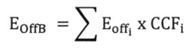
Where:
a) Eoffi: Balance of the off-balance-sheet commitment of the i-th receivable as prescribed by the regulations of the State Bank Governor on capital adequacy ratios applied by the bank;
b) CCFi: Conversion factor of the off-balance-sheet commitment of the i-th receivable as prescribed by the regulations of the State Bank Governor on capital adequacy ratios applied by the bank.
Appendix IV
INFORMATION DISCLOSURE ON LIQUIDITY RATIOS
(Attached to Circular No. 50/2026/TT-NHNN dated September 30, 2026 of the Governor of the State Bank)
Information disclosed by a bank in accordance with its internal regulations and consistent with this Circular shall include at least the following:
1. Basic information in the bank’s internal regulations on liquidity risk management
a) A summary of the liquidity risk management policy, including strategy, risk management principles and liquidity risk appetite;
b) Key definitions used in liquidity risk management;
c) The bank’s funding and asset structure;
d) Liquidity risk control measures.
2. Overview of the organizational structure for liquidity risk management, including information on the bank’s divisions performing liquidity risk management; the approach to liquidity risk management (centralized or decentralized).
3. Quantitative details of liquidity ratios
a) Standalone LCR;
b) Standalone NSFR;
c) LDR;
d) Standalone LEV in case the State Bank Governor decides to apply it.
4. Other information (if any) in accordance with the bank’s internal regulations and based on the information disclosure guidelines of the Basel Committee.
You are not logged in.
This feature is available to Advanced account holders. Please log in to access detailed information on Related documents.
If you do not have an account, please register here!
VIETNAMESE DOCUMENTS

This utility is available to subscribers only. Please log in to a subscriber account to download. Don’t have an account? Register here

This utility is available to subscribers only. Please log in to a subscriber account to download. Don’t have an account? Register here
This utility is available to subscribers only. Please log in to a subscriber account to download. Don’t have an account? Register here
This utility is available to subscribers only. Please log in to a subscriber account to download. Don’t have an account? Register here
This utility is available to subscribers only. Please log in to a subscriber account to download. Don’t have an account? Register here
This utility is available to subscribers only. Please log in to a subscriber account to download. Don’t have an account? Register here
ENGLISH DOCUMENTS
This utility is available to subscribers only. Please log in to a subscriber account to download. Don’t have an account? Register here
This utility is available to subscribers only. Please log in to a subscriber account to download. Don’t have an account? Register here
This utility is available to subscribers only. Please log in to a subscriber account to download. Don’t have an account? Register here

